

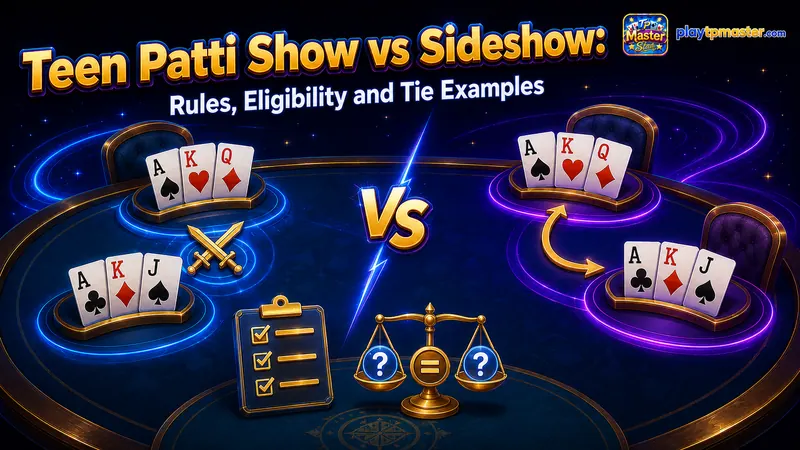
A show and a sideshow both compare Teen Patti hands, but they serve different purposes. A show is normally the final comparison between the last two active players and ends the round. A sideshow, also known as a compromise, is an earlier private comparison between two eligible seen players. It usually removes only the weaker of those two players, allowing the round to continue.
Eligibility, payment and tie rules vary between tables. Players should not assume that a procedure learned in one app applies everywhere.
On this page
Show vs Sideshow: Quick Comparison
Swipe sideways to see every column.
| Rule | Show | Sideshow |
|---|---|---|
| Typical active players | Two | Usually three or more may remain |
| Eligible status | Depends on blind and seen positions | Normally seen players only |
| Cards compared | Final two hands | Requester and previous eligible seen player |
| Visibility | Usually final or public | Usually private |
| Can request be refused? | Normally not after a valid request | Often yes |
| Result | Round ends | Weaker compared player packs |
| Exact tie | Split pot or requester loses | Requester commonly loses |
The app or agreed house rules take priority over this common structure.
What Is a Final Show?
A final show occurs when only two active players remain. One of them requests the comparison and pays the required amount. The hands are evaluated according to the standard ranking order.
Swipe sideways to see every column.
| Rank | Hand category |
|---|---|
| 1 | Trail or Trio |
| 2 | Pure Sequence |
| 3 | Sequence |
| 4 | Colour |
| 5 | Pair |
| 6 | High Card |
The winner receives the pot. If the hands belong to the same category, internal tie-breaking rules apply.
Who Can Request a Show?
When both final players are blind, either can commonly request a show. When both are seen, either may normally request it by paying the applicable amount.
In a blind-versus-seen situation, many traditional rules allow the blind player to request the show but prevent the seen player from forcing the blind opponent into one. Some apps use different logic and simply display the show button to whichever player is eligible.
What Is a Sideshow?
A sideshow allows a seen player to request a private hand comparison with the previous eligible seen participant. It can occur before the game reaches its final two players.
The recipient usually has a choice. Accepting triggers the comparison; rejecting keeps both players active. The wider table does not normally see the cards.
Who Is Eligible for a Sideshow?
The requester must normally be seen. The person receiving the request must also be seen and active. Under some app-specific rules, blind and folded participants may be skipped when selecting an opponent. This is not universal: the traditional procedure described by Pagat requires all remaining players to be seen and compares the requester with the immediately previous bettor.
Suppose the active order is:
Swipe sideways to see every column.
| Player | Status |
|---|---|
| A | Seen |
| B | Blind |
| C | Seen |
| D | Packed |
| E | Seen and acting |
In a version that permits skipping to the previous active seen participant, Player E would request the sideshow from Player C. Under the all-players-seen rule, no sideshow is available while Player B remains blind. Player D is no longer active, while Player B remains blind. Exact selection logic can differ in digital versions.
Can a Sideshow Be Rejected?
Yes, under many common rules. If the recipient rejects the request, no cards are compared and neither player packs. The round proceeds normally.
A rejected sideshow does not usually refund a normal chaal already paid for that turn. Some games restrict repeated requests so that one player cannot continually interrupt the round.
What Happens After an Accepted Sideshow?
Only the two relevant hands are compared. The player with the lower-ranked hand packs, while the stronger hand remains active.
For example, Player A holds Q♠-Q♦-6♣ and Player B holds J♥-J♣-A♦. Player A wins the comparison because a pair of queens outranks a pair of jacks. Player B’s ace kicker matters only if the pair ranks are equal.
The other active players continue without seeing either hand.
Pair Tie Example
Player A holds 10♠-10♥-K♣. Player B holds 10♦-10♣-8♥. Both have a pair of tens, so the unmatched card decides the comparison. Player A wins with a king kicker.
If both kickers were kings, the hands would be exactly equal in rank. Suit normally would not break that tie.
Colour Tie Example
Player A holds A♠-J♠-5♠. Player B holds A♦-10♦-9♦. Both have colours. Their aces match, so the second cards are compared. Player A wins because jack is higher than ten.
If the first two ranks match, compare the third. The total of the three cards is not used.
High-Card Tie Example
Player A holds K♠-9♦-7♣. Player B holds K♥-9♣-5♦. The king and nine match, so the final card decides the result. Player A wins with seven over five.
Again, suits normally have no ranking value.
Exact Tie in a Final Show
Suppose Player A has 8♠-8♥-Q♣ and Player B has 8♦-8♣-Q♥. Both have a pair of eights and a queen kicker.
Some tables divide the pot. Others award the comparison to the non-requesting player, meaning the show requester loses. The procedure should be displayed before the request is confirmed.
Exact Tie in a Sideshow
In many traditional versions, an equal sideshow causes the requester to pack. This gives the recipient protection for accepting the comparison.
For example, a requester with A♠-10♦-6♣ and a recipient with A♥-10♣-6♦ may be equal. Under the requester-loses rule, the requester exits. Other tables may cancel the comparison or apply another house rule.
Show and Sideshow Costs
Both actions normally require a contribution, but the formula varies. A sideshow requester commonly pays the required seen-player amount. A final show may cost the current stake, twice the current stake or a fixed displayed amount.
Swipe sideways to see every column.
| Cost factor | Why it matters |
|---|---|
| Current stake | Base for calculating the request |
| Blind or seen status | May change the required multiplier |
| Table limit | Restricts the maximum amount |
| Pot limit | May force a final comparison |
| App variation | Can replace traditional formulas |
Does Sideshow End the Round?
Usually not. It removes one of the two compared players, after which the normal turns continue. Under the usual three-or-more-player eligibility rule, removing one player leaves at least two active, so a sideshow does not award the final pot.
A valid final show always determines the winner and ends the round.
Common Mistakes
Blind players sometimes attempt to request a sideshow. They generally must become seen first. Players also confuse “previous participant” with the person physically sitting immediately to the right; some app variants skip folded or blind players, while the traditional all-seen procedure does not permit the request until every active player is seen.
Another mistake is assuming that the recipient must accept. Rejection is allowed under many systems. Finally, exact ties are not necessarily divided, especially when the requester-loses rule applies.
Frequently Asked Questions
Is a sideshow the same as a show?
No. A show is the final comparison; a sideshow is an earlier private comparison between eligible seen players.
Can a blind player request a sideshow?
Normally not. The player must first view the cards and become seen.
Can the recipient reject a sideshow?
Yes, under many rules. Both hands then remain active and private.
Who loses an equal sideshow?
The requester commonly loses, although the table may specify another result.
Are sideshow cards revealed to everyone?
Normally no. Only the result is applied, and the cards remain private.
What happens after a final-show tie?
The pot may be split or the requester may lose. Check the specific table rule.
Responsible-Play Notice
A comparison can reveal which hand is stronger, but it cannot remove the chance involved in the deal. Use free-play chips when learning and do not increase contributions simply to recover earlier losses.
Conclusion
A show determines the final winner when two players remain. A sideshow is a private comparison between eligible seen players before the final stage, and the recipient can often decline it.
The largest rule differences involve blind-versus-seen eligibility, request cost and exact ties. Confirming these points before play avoids most disputes.
Review cycle: every 90 days.