
This page focuses on the Ultimate Teen Patti app and its published rules. Use the main rules reference for a broader guide to traditional Teen Patti.
On this page
What Is Ultimate Teen Patti?
Ultimate Teen Patti, often abbreviated UTP, is a social card-game app name with identifiable publisher material. Its published rules describe ordinary Teen Patti alongside additional variations and state that the game is for entertainment without monetary payouts.
The phrase can also appear in generic article titles, so distinguish the branded application from an “ultimate guide” to the traditional game. Match the specific product and its support records before downloading anything.
Public pages may differ in age and promotional details. This guide focuses on the basic game and useful worked examples rather than repeating welcome-chip figures that may no longer apply. The live table controls the exact limits, variation and comparison procedure.
The Aim of a Round
Players compete for a pot. You win if every other participant packs, or if your hand wins an eligible final comparison against the remaining opponent.
A round therefore does not always end with all players showing their cards. If everyone else folds, the last player can win even with a weak hand.
In classic play, each player normally receives three cards and does not draw replacements. The decisions concern continuing, looking, raising where allowed, packing and requesting comparisons.
Special modes can change this structure. Read the selected mode's explanation before applying ordinary Teen Patti assumptions.
How a Round Begins
The boot is the initial contribution placed into the pot before the deal. Every participating player contributes the required amount, then receives three face-down cards.
The first turn commonly belongs to the player on the dealer's left, with action continuing clockwise. An app handles dealing and turn order automatically, but the player should still understand when an action is required.
Check the boot before joining. A high starting balance does not make a table low risk if the opening and later contributions consume it quickly.
The pot display also should not be confused with personal profit. A winner receives a pot containing some of their own earlier contributions.
Ultimate Teen Patti Hand Rankings
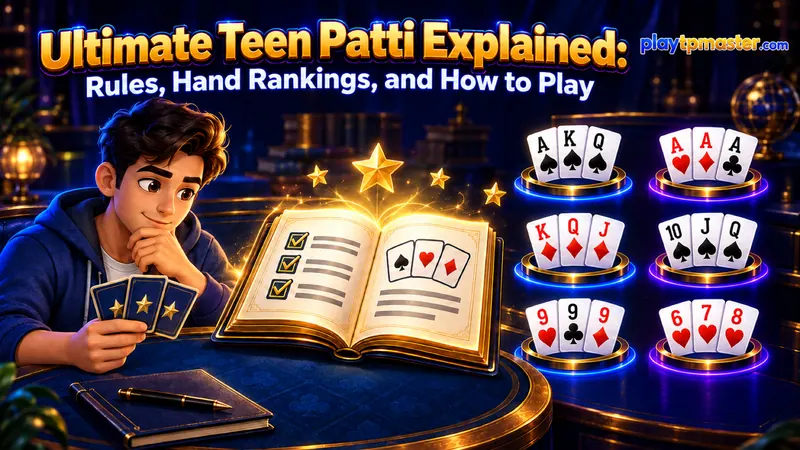
The published Ultimate Teen Patti rules use the familiar category order from Trail to High Card. They also describe winning by opponents folding or by a final Show.
Swipe sideways to see every column.
| Rank | Category | Example |
|---|---|---|
| 1 | Trail or Trio | K♠, K♥, K♦ |
| 2 | Pure Sequence | 7♣, 8♣, 9♣ |
| 3 | Sequence | 10♠, J♥, Q♦ |
| 4 | Colour | A♦, J♦, 8♦ |
| 5 | Pair | 6♠, 6♥, Q♣ |
| 6 | High Card | A♣, J♦, 7♥ |
Identify the category first. Cards of one suit that are also consecutive form a Pure Sequence, rather than an ordinary Colour. Cards with consecutive ranks in mixed suits form a Sequence.
Three equal ranks form a Trail. Under standard ranking, even a low Trail beats a Pure Sequence.
Worked Example: Category Before Card Height
Player A holds 3♠, 3♥, 3♦. Player B holds A♥, K♥, Q♥.
Player A wins under the standard hierarchy because a Trail outranks a Pure Sequence. The fact that Player B holds an Ace does not override the category ranking.
Now compare 5♣, 6♣, 7♣ with A♠, K♦, Q♥. The first hand is a Pure Sequence and wins against the second hand's ordinary Sequence.
These examples avoid the A-2-3-versus-A-K-Q ordering question because the categories already decide the result. When both hands are sequences of the same category, the table's internal run order matters.
Comparing Pairs, Colours and High Cards
For pairs, compare the paired rank first. A pair of tens beats a pair of nines regardless of the third card. If both players have tens, compare the kicker.
For example, 10♠, 10♥, A♦ beats 10♣, 10♦, K♠ because the pairs match and the Ace outranks the King.
For Colours, arrange ranks from high to low. A-Q-8 beats A-J-10 because the Aces match and the Queen exceeds the Jack. You do not need to compare the lowest card after that difference decides the hand.
The same descending comparison applies to ordinary High Card hands. Suits should not be used as a tie-break unless the active rules explicitly say so.
Blind and Seen Play
A blind player has not viewed their hand. A seen player has looked. Once a player sees the cards, the hand does not become blind again.
The contribution required from a seen player is commonly twice the corresponding blind amount. For a fictional table with a current blind stake of five chips, a minimum seen action would be ten under that convention.
Raises can change the current stake, so do not keep using the initial boot as the continuation amount throughout the round. Follow the amount displayed for the active turn and check any maximum increase.
Looking at cards provides information, but it does not change the cards or guarantee a better outcome.
Pack, Show and Sideshow
Packing removes the player from the current hand and leaves prior contributions in the pot. It is a normal action, not an account penalty.
A Show is a final comparison when only two players remain. A Sideshow is a private comparison within a round involving additional players, subject to eligibility and acceptance rules.
UTP's published rules state that the requester loses when compared hands are equal in the described Show and Sideshow procedures. They also explain that an accepted Sideshow removes the weaker hand. Check the current mode for eligibility, payment and timing before using the feature.
A button being unavailable may reflect the number of remaining players or blind status rather than an application error.
Worked Example: Pot Value and Net Result
Consider a fictional practice round with three players. Each contributes a five-chip boot, creating a fifteen-chip pot.
Each player then contributes ten chips while seen, bringing the pot to forty-five. Two players later pack without further contributions, so the remaining player wins the pot.
The winner contributed fifteen chips in total. Receiving forty-five therefore creates a net gain of thirty chips, not forty-five.
This calculation is useful when checking a balance summary. A game may display the pot award while the account history also shows the earlier deductions. Both figures can be correct if interpreted consistently.
Variations Require a Fresh Rule Check
UTP's published material describes variations such as Muflis, joker formats and increased-boot play. Availability in a particular release should be verified from the live menu.
Do not assume that a name used by another app has identical rules. A joker mode can choose wild cards differently, and a low-hand mode can change both category order and tie evaluation.
When starting a variation, answer three questions: which cards are special, what kind of hand wins, and how ties are decided. Then check the boot and contribution limits.
For detailed comparison of traditional variants, use the site's Teen Patti variations guide as background and the current table as the implementation reference.
Starting in the App
After verifying the application source, open the available help or rules area. Find a classic mode and inspect its table summary before confirming entry.
The exact menu location can change, so a screenshot from an older article should not be treated as a guaranteed button path. Look for the mode name, required balance, boot and rules icon.
If you use a guest account, understand its recovery limits. Record the player ID and connect a supported login method when appropriate before reinstalling or changing phones.
This guide has not independently tested current lobby controls, so it does not claim a fixed sequence of registration screens.
Virtual Chips and Purchase Boundaries
The publisher describes UTP as a social entertainment game without real-money payouts. A virtual-chip reward should therefore not be advertised as cash income.
Check the current terms for any optional purchase, timed reward or event. A large chip amount does not establish long playtime without considering the table limits.
Avoid third-party chip sellers, account traders and modified APKs. A seller may retain account recovery access, and an unofficial file may have a different signing identity or harmful permissions.
Support should never require your password or one-time login code to explain a missing reward.
Beginner Mistakes to Avoid
The most common rules mistake is comparing only the highest card instead of the category. Another is assuming that all games rank A23 and AKQ identically.
Players also confuse the boot with every later contribution or mistake the displayed pot for net winnings. The examples above show why those amounts need separate treatment.
Finally, do not continue simply because you have already contributed. Earlier chips are already in the pot; the next action is a new decision under the current information and limits.
Frequently Asked Questions
Is Ultimate Teen Patti the same as Teen Patti Master?
No shared application identity is established by the names. Verify each publisher, package and account system independently.
What is the strongest standard category?
A Trail ranks above Pure Sequence in the standard hierarchy described here.
Can I win without showing my cards?
Yes. If every other player packs, the remaining player wins the pot under ordinary rules.
Can I withdraw UTP chips as money?
The publisher describes the game as social entertainment without monetary payouts. Do not rely on a third-party claim that says otherwise.
Conclusion
Ultimate Teen Patti follows a recognizable three-card foundation: boot, deal, blind or seen play, packing and eligible comparisons. Learn the category hierarchy first, then check the exact table limits and special-mode rules.
Verify the current application and treat chips according to the published virtual-item terms. No combination of branding, bonuses or confident strategy claims guarantees a winning result.
Risk note: Keep optional purchases within a fixed entertainment budget, take breaks and stop if play becomes stressful or difficult to control.