

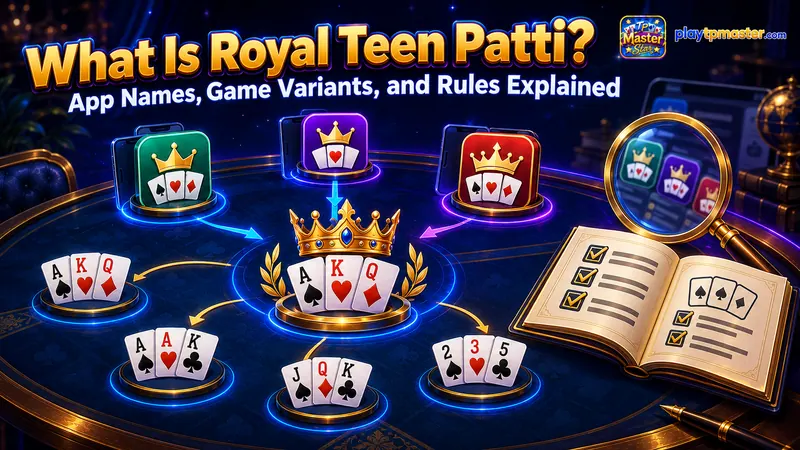
“Royal Teen Patti” can refer to an application name, a named variation inside another app or descriptive wording used in a game guide.
Those meanings should be separated before you download anything or apply a set of rules. An app called Royal Teenpatti may contain ordinary classic tables and several other modes. A Royal mode inside another product may change the deck or gameplay without being a separate application.
The name alone does not establish the developer, number of cards, hand rankings or availability of withdrawals.
This guide explains the distinction, identifies one matched store listing and uses a clearly stated reduced-deck example to show how a Royal-style variation can work.
On this page
Royal Teen Patti as an Application Name
One identifiable Google Play product is Royal Teenpatti - RTP, listed under Tubbgames, with the Android application ID:
com.rtp.royalteenpatti
Its description presents a collection of games and Teen Patti variations rather than one universal Royal ruleset. The listing also states that the game does not offer real-money gambling or opportunities to win real money or prizes. Royal Teenpatti - RTP on Google Play.
These details identify that particular listing. They should not be transferred to every APK or website using similar words.
Likewise, identifying a store record does not independently verify every marketing statement, performance claim or privacy practice. It provides a starting point for matching the product you intend to use.
Royal as a Mode Inside Another App
“Royal” can also appear among the variations offered by an application with a different name.
For example, the Teen Patti Gold store description lists Royal alongside other modes. That establishes the publisher’s use of the mode name, but the brief listing does not provide a complete Royal rulebook. Teen Patti Gold’s listed variations.
To learn the actual rules, open the relevant table information or help section. Check which cards are included and whether the standard ranking order changes.
Do not assume that downloading an app with “Royal” in its title gives you the same game as selecting Royal inside another app.
Three Meanings to Keep Separate
Swipe sideways to see every column.
| Use of “Royal” | What it describes | What to verify |
|---|---|---|
| Application title | A particular software product | Developer, package ID and store listing |
| Game-mode name | A ruleset inside a product | Deck, wild cards, ranking and show rules |
| Promotional wording | A theme, table name or marketing description | Whether any actual rule change is documented |
This distinction also explains why two articles can give different answers to “How many cards are used in Royal Teen Patti?”
They may be discussing different implementations. Alternatively, one may have copied a rule without identifying its source.
A useful rules article should state the exact deck composition instead of relying on the word “Royal.”
A Reduced-Deck Royal Example
To make the gameplay concrete, the following examples use a 20-card teaching ruleset.
Keep the tens, jacks, queens, kings and aces from all four suits. Remove the twos through nines and all printed jokers.
This example illustrates reduced-deck play. It is not a claim that every application or Royal table uses these exact rules.
Swipe sideways to see every column.
| Rank retained | Cards |
|---|---|
| Ten | 10♣, 10♦, 10♥, 10♠ |
| Jack | J♣, J♦, J♥, J♠ |
| Queen | Q♣, Q♦, Q♥, Q♠ |
| King | K♣, K♦, K♥, K♠ |
| Ace | A♣, A♦, A♥, A♠ |
The total is five ranks multiplied by four suits: twenty cards.
Do not describe this as a deck containing only face cards. Jacks, queens and kings are face cards; tens and aces are separate ranks.
If a table instead retains only J, Q, K and A, its sixteen-card deck is a different setup and must be evaluated accordingly.
How the Example Round Begins
For a home practice game, use four players and tokens with no monetary value.
Each player contributes the agreed boot, and the dealer gives each person three cards face down. Players then follow the blind, seen, folding and show procedures agreed before the deal.
Removing cards does not by itself define those procedures. You must still establish contribution limits, show eligibility and tie outcomes.
For this example, there are no wild cards, and the ordinary category order remains in place. Aces are high, and sequences do not wrap around.
With those assumptions, the possible sequence ranks are 10–J–Q, J–Q–K and Q–K–A.
A–2–3 cannot appear because the deck contains no twos or threes.
Hand Rankings in the Example Ruleset
Swipe sideways to see every column.
| Rank | Category | Example |
|---|---|---|
| 1 | Trail | Q♣–Q♦–Q♥ |
| 2 | Pure sequence | Q♠–K♠–A♠ |
| 3 | Sequence | J♣–Q♦–K♥ |
| 4 | Colour | A♥–J♥–10♥ |
| 5 | Pair | K♣–K♦–10♠ |
| 6 | High card | A♣–Q♦–10♥ |
The highest category wins, even when a lower category contains impressive individual cards.
The reduced deck changes which hands can occur and how often they occur. It does not automatically change the category order.
If your actual table uses a different hierarchy, follow that hierarchy rather than importing the example chart.
Worked Example 1: A Trail Beats a Suited Sequence
Player A holds J♣–J♦–J♥.
Player B holds Q♠–K♠–A♠.
Player A has a trail of jacks. Player B has an ace-high pure sequence.
Under the stated category order, Player A wins. The fact that Player B’s cards are all higher in printed rank does not override the trail category.
This is the same category-first principle used in classic Teen Patti. A name such as “Royal” does not automatically promote a suited ace sequence above a trail.
Worked Example 2: Comparing Two Sequences
Player A holds 10♣–J♦–Q♥.
Player B holds J♠–Q♣–K♦.
Both hands are ordinary mixed-suit sequences. Player B wins because J–Q–K ranks above 10–J–Q in the example ruleset.
Now change Player A’s cards to 10♥–J♥–Q♥.
Player A has a pure sequence and wins against Player B’s ordinary sequence. The suit pattern changes the category, so category takes priority over the sequence’s highest card.
Worked Example 3: Comparing Matching Pairs
Player A holds Q♣–Q♦–A♥.
Player B holds Q♥–Q♠–K♣.
Both players have a pair of queens. Compare the unmatched cards: ace against king.
Player A wins.
However, K♦–K♥–10♣ would beat either queen pair because paired rank is considered before the kicker.
Do not compare the highest single card first when evaluating pairs. That method belongs to high-card and colour comparisons.
Worked Example 4: A Colour Is Still Possible
Player A holds A♥–J♥–10♥.
These cards share a suit but do not form a consecutive run, so the hand is a colour.
Player B holds A♠–Q♠–10♠, another colour.
Compare the highest cards first. Both have an ace. Next compare queen against jack, giving Player B the win.
The reduced deck does not mean every same-suit hand becomes a sequence. You still need to inspect the ranks.
Why a Smaller Deck Changes Hand Frequency
With fewer ranks in the deck, matching ranks become easier to encounter than in a full 52-card deck.
The effect can be illustrated exactly for trails. In the 20-card teaching deck, there are 1,140 possible three-card combinations. Each of the five ranks has four ways to choose three suits, giving 20 possible trails.
That makes the trail frequency about 1.75% for a uniformly shuffled random three-card deal from this example deck.
In a standard 52-card deck, there are 52 trails among 22,100 three-card combinations, or about 0.24%.
These are calculated frequencies of receiving a category, not chances of winning a round. Opponents draw from the same deck, and their hands are related through the cards already dealt.
A more frequent strong category does not create a guaranteed advantage for any player.
Rules to Check Before Entering a Royal Table
Confirm the actual ranks included. “High cards only” is too vague to distinguish a sixteen-card deck from a twenty-card deck.
Next, check whether any cards are wild and whether the usual category order is retained. Then inspect the sequence order, suit treatment and exact-tie procedure.
Player capacity also follows the available cards. A single twenty-card deck can supply six three-card hands with two cards remaining, before accounting for any additional exposed or reserved cards. The app may impose a lower seat limit.
Finally, check blind-turn limits, contribution caps and automatic-show conditions. None of these can be deduced solely from the deck size.
App Identity and Account Safety
Before installing a Royal Teen Patti APK, match it to the intended developer and package.
An app title, royal-themed icon or familiar screenshot does not establish that two downloads share an account system.
Do not assume that purchases, balances or Player IDs transfer between similarly named products. Preserve your login and recovery information before replacing an installed app.
Also distinguish virtual chips from redeemable balances. The verified listing discussed earlier states its own non-cash terms; that statement should not be generalised to unrelated products.
Frequently Asked Questions
Is Royal Teen Patti one official game?
The phrase is used for applications and modes. Identify the specific product and ruleset.
Does Royal always use twenty cards?
No universal deck size should be assumed. This guide uses twenty cards for its worked example.
Is Royal the same as a royal flush?
No. A poker royal flush is a five-card combination. A three-card Teen Patti hand follows its own categories.
Are aces automatically wild?
Not in the teaching ruleset here. Aces become wild only if the selected mode explicitly says so.
Is Royal easier to win than classic Teen Patti?
More frequent strong combinations also affect opponents. There is no guaranteed winning method. Learn with non-redeemable tokens, keep spending optional and bounded, and stop when play begins to feel like an attempt to recover losses.
Review cycle: every 90 days.