
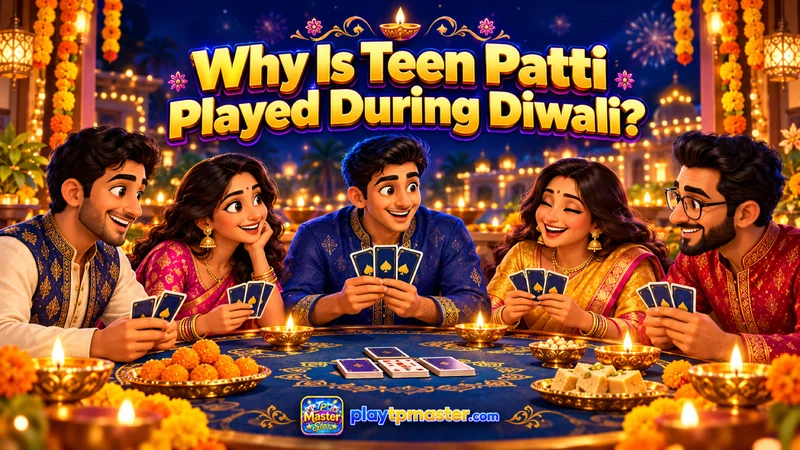
Teen Patti is played during Diwali in some families and friendship groups because it combines festive ideas about luck with an easy-to-organize social activity. A deck of cards gives people something to do together between conversations, food, and visits. For many participants, the attraction is the gathering as much as the game.
That does not make Teen Patti a compulsory Diwali ritual. Customs differ across households, regions, and religious communities, and many people celebrate without playing cards at all. The most accurate explanation separates older stories about dice and auspicious fortune from the modern habit of arranging a Teen Patti evening.
On this page
The Connection Between Diwali and Games of Chance
Accounts of Diwali traditions include dice-play alongside worship, lamps, hospitality, and celebrations of prosperity. One religious narrative describes Shiva and Parvati playing dice, with Parvati winning. Such stories help explain why chance and good fortune appear in some descriptions of festive play.
However, a story about dice is not evidence that the deities played modern Teen Patti. It also does not establish the invention date of the three-card game or an uninterrupted history of one fixed set of rules. The broader association is between the festive period and play involving chance, not a historical claim that today’s card table exactly reproduces an ancient scene.
This distinction matters when explaining the custom to someone unfamiliar with it. “Some families connect festive card play with stories about luck” is more accurate than “Diwali requires everyone to gamble.” The first describes a tradition; the second turns a varied practice into a universal obligation.
Why Teen Patti Fits a Social Gathering
Teen Patti uses three cards per player and a relatively short list of hand categories. A beginner can learn what a pair, sequence, colour, and trail look like through a few face-up examples. That makes it possible to introduce the game without spending the whole gathering explaining a complex board or preparing specialized equipment.
The small hand also leaves room for conversation. Players can follow a round without continuously arranging a large collection of pieces. Dealing, comparing hands, and rotating the dealer provide a shared rhythm while guests catch up.
These are practical reasons the game can suit a party, not proof that every person finds it easy. Blind and seen contributions, ace-sequence rankings, and show rules can still confuse newcomers. A welcoming host makes those details visible instead of assuming that familiarity with Diwali means familiarity with cards.
Prosperity Symbolism Is Not a Prediction
Lakshmi worship and hopes for prosperity are important parts of Diwali observance for many households. In festive conversation, a lucky hand may therefore become a lighthearted symbol of an auspicious beginning or a fortunate year.
A symbol is not a probability rule. Winning a card round does not predict financial success, and losing one does not forecast misfortune. A person who chooses not to play has not missed a necessary opportunity to secure good luck.
This is especially important when jokes become pressure. Telling a guest that they must join to avoid bad luck, or that they should keep playing until they win, changes a voluntary activity into an uncomfortable obligation. The festive meaning works better when everyone can participate, watch, or decline without needing to defend the decision.
A Family Custom Is Not the Same as a Universal Rule
Two families can both describe their card nights as traditional while using different games, schedules, and boundaries. One might play after a meal; another might arrange a separate evening before the main celebration. Some may prefer rummy, another card game, or no cards at all.
Even two Teen Patti tables can disagree about A23 versus AKQ. That is a game-rule difference, not a test of whose celebration is more authentic. A host should settle the table convention before dealing rather than appealing to “how everyone plays.”
Swipe sideways if the table is wider than your screen.
| Statement you might hear | A more careful interpretation |
|---|---|
| We always play cards at Diwali | This household has a recurring custom |
| A winning hand means a lucky year | This is a symbolic belief, not a prediction |
| Everyone knows these rules | Guests may know different versions or none |
| It only counts if money is involved | A social card evening can use valueless counters |
Recognizing those differences makes room for both enthusiastic players and guests whose Diwali traditions centre on other activities.
How Traditions Continue Through Shared Memories
A card evening can become memorable because of who was there, not because of which cards appeared. A relative patiently explaining a hand, a friend misunderstanding a rule and laughing about it, or a familiar snack arriving at the table can become the story remembered the next year.
For a host, that suggests a useful priority: preserve the welcome rather than every competitive detail. If a customary rule makes the game difficult for a newcomer, explain it carefully or agree on a simpler practice round. If someone needs to leave early, make that easy rather than treating departure as spoiling the table.
You can also ask guests about their own experiences. A question such as “What games did your family play during festivals?” invites conversation without assuming a shared background. It may reveal another activity that the group would enjoy as much as Teen Patti.
Keeping a Card Party Separate from Worship
A household may include both religious observance and social entertainment in its celebrations, but the two need not happen at the same time or carry the same meaning. Ask the host when a game would be appropriate and whether particular spaces should remain quiet or clear.
This is a practical courtesy, not a universal timetable. A game should not delay a meal, interrupt a ceremony, or require someone to choose between family responsibilities and keeping their seat. Put the cards away when another part of the evening begins.
For mixed gatherings, provide an equally welcoming place for people who are not playing. Conversation, music, or another non-wagering activity should feel like part of the party, not a waiting area for those excluded from the main event.
Preserving the Fun Without Financial Pressure
A no-money format keeps the focus on company and learning. Give each adult participant the same number of counters, state that counters cannot be purchased or exchanged for cash or prizes, and end the session at an agreed time. There is no need to turn the final count into a reward scheme.
Avoid loans, repayment promises, or informal “we will settle later” arrangements. Calling something friendly does not remove the tension that can arise when people spend more than intended. A simple game becomes easier to host when nobody needs to recover losses before going home.
The same boundary applies to digital invitations. A Diwali greeting does not make an attached game installer trustworthy, and a festive bonus banner does not create a reason to download software. An offline deck is enough for a social evening; no guest should need to install an unfamiliar app to belong.
What the Tradition Can Mean Today
The connection between Teen Patti and Diwali is best understood as a mixture of cultural symbolism, household habit, and sociability. Older stories give some people a language of luck; the modern card table gives friends a way to spend time together.
Neither part requires a claim that winning cards bring wealth or that every family should take part. A thoughtful celebration leaves room for different beliefs and preferences. If the gathering produces good conversation and everyone feels comfortable leaving the table, the social purpose has been served regardless of who held the strongest hand.