
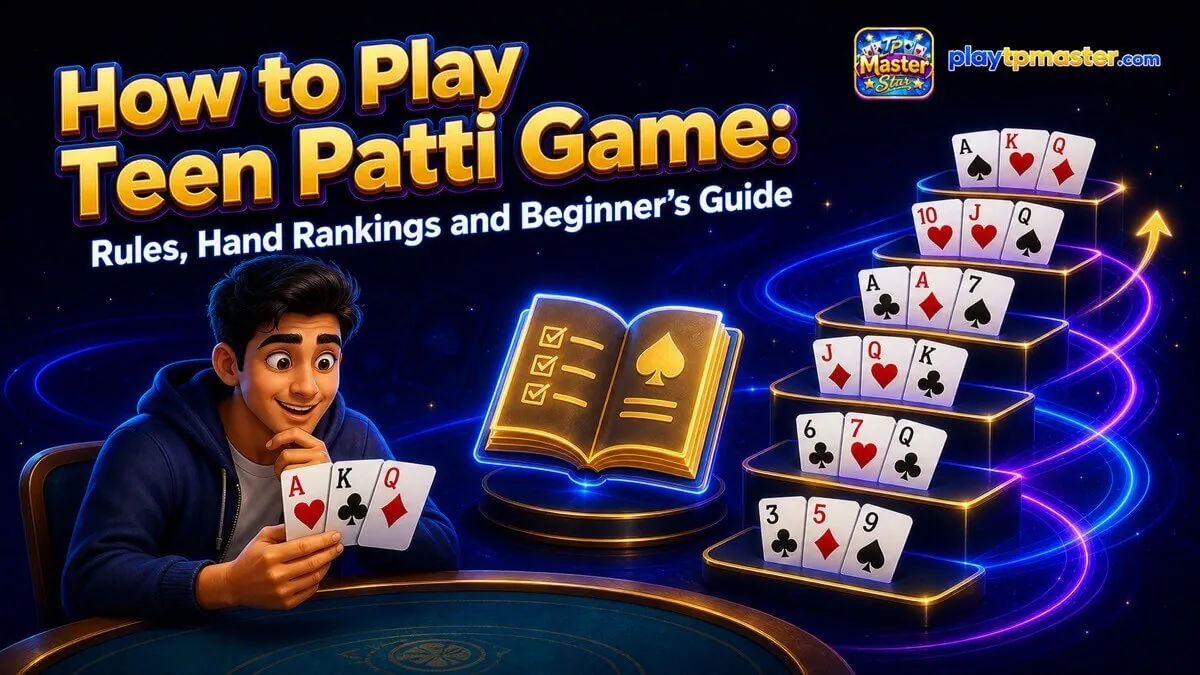
Teen Patti is a popular three-card game that originated in the Indian subcontinent. Its name means “three cards,” and the game is sometimes described as a simplified version of poker. Teen Patti is commonly played at family gatherings and social events, although digital versions are also available on mobile devices.
While the basic rules are easy to understand, beginners should learn the hand rankings, betting terms and table limits before joining a game. This guide explains how to play Teen Patti, how hands are compared and what safety precautions to consider when using a Teen Patti game app.
What Is the Teen Patti Game?
Teen Patti is a card game usually played by three to six participants using a standard deck of 52 cards without jokers. Every player receives three face-down cards. Players then decide whether to continue, raise the current stake or leave the round.
The objective is to hold the highest-ranking three-card hand or remain in the game after the other players have folded.
A standard Teen Patti round generally includes:
| Game element | Description |
|---|---|
| Number of players | Usually 3–6 |
| Cards used | Standard 52-card deck |
| Cards per player | Three |
| Jokers | Not used in the traditional version |
| Main objective | Hold the best hand or make the other players fold |
| Common play styles | Blind and seen |
Teen Patti has many regional and app-based variations. Therefore, table rules should always be checked before a round begins.
How a Teen Patti Round Works
1. Choose the Dealer
One participant is selected as the dealer. The dealer shuffles the deck and distributes three cards face down to every player. The dealer position may rotate clockwise after each round, depending on the rules being used.
2. Place the Boot Amount
Before cards are dealt, every player contributes a fixed starting amount to the central pot. This contribution is commonly known as the boot amount. The boot creates the initial pot and gives players something to compete for. In a casual game, it may simply consist of points, tokens or chips with no monetary value.
3. Receive Three Cards
Each player receives three face-down cards. Players should not show their cards to anyone else. After receiving the cards, a participant may choose to play blind without looking at them or become a seen player by checking the hand.
4. Take Turns
The action usually moves clockwise from the dealer. During a turn, a player can place the required stake, raise the amount or fold. The exact betting requirements may differ between blind and seen players. Many Teen Patti versions require seen players to contribute more than blind players.
5. Continue or Fold
Players continue taking turns until most participants fold or the remaining players request a final comparison. A player who folds gives up any amount already placed into the pot and takes no further part in that round.
6. Compare the Remaining Hands
When two players remain, one may request a show if the table rules allow it. Their cards are revealed and compared according to the Teen Patti hand-ranking system. The player with the stronger hand wins the pot.
Teen Patti Hand Rankings from Highest to Lowest
Understanding the hand rankings is one of the most important parts of learning the Teen Patti game.
| Rank | Hand | Example | Explanation |
|---|---|---|---|
| 1 | Trail or Trio | A-A-A | Three cards of the same rank |
| 2 | Pure Sequence | A-K-Q of one suit | Three consecutive cards of the same suit |
| 3 | Sequence | 7-8-9 of mixed suits | Three consecutive cards in different suits |
| 4 | Color | A-J-7 of one suit | Three cards of the same suit that are not consecutive |
| 5 | Pair | K-K-5 | Two cards of the same rank |
| 6 | High Card | A-J-8 | A hand that does not form another combination |
A trail is normally the strongest Teen Patti hand. In many traditional versions, three aces are the highest possible trail.
Rules for sequences involving an ace can vary. For example, some tables recognize A-K-Q and A-2-3 as valid sequences, while others apply different ranking rules. Players should confirm this before starting.
Blind Player vs Seen Player
A blind player participates without looking at the three cards. Because the player does not know the strength of the hand, the required stake is usually lower.
A seen player, sometimes called a chaal player, has looked at the cards. This provides more information but may result in a higher minimum stake.
Neither choice guarantees an advantage. Blind play involves greater uncertainty, while seen play may encourage players to continue with an average hand simply because they already know what they hold.
Important Teen Patti Terms
Teen Patti platforms and local games may use slightly different terminology, but beginners will frequently encounter the following terms:
| Term | Meaning |
|---|---|
| Boot | The initial contribution placed into the pot |
| Pot | The total chips or points contributed during a round |
| Blind | Playing without checking the cards |
| Seen or Chaal | Playing after looking at the cards |
| Fold or Pack | Leaving the current round |
| Show | Comparing the final hands |
| Side Show | A private comparison between eligible players |
| Stake | The amount contributed during a turn |
A side show is not available under every rule set. Where it is permitted, one seen player may request a private comparison with another seen player. The other participant may be allowed to accept or reject the request.
Common Teen Patti Variations
The traditional game uses fixed hand rankings and no wild cards, but many applications offer additional modes.
Muflis reverses the normal ranking system, so the weakest conventional hand may become the winning hand.
AK47 treats aces, kings, fours and sevens as jokers or wild cards. These cards can be used to complete combinations.
Joker Teen Patti designates one or more ranks as wild cards. The method used to select jokers depends on the platform.
Because variations can change both strategy and hand strength, players should read the in-game rules rather than assuming every table follows the traditional format.
Beginner Tips for Playing Teen Patti
Start by memorizing the six standard hand categories. Without knowing the ranking system, it is difficult to judge whether a hand is strong or weak.
Set a clear session limit before playing. This may include a time limit and, where legally permitted real-money play is involved, a strict spending limit. Do not increase the limit to recover a previous loss.
Pay attention to the table rules. Minimum stakes, maximum stakes, side-show conditions and sequence rankings can vary between games.
Avoid treating previous results as a prediction of the next deal. Teen Patti uses shuffled cards, so a winning or losing streak does not guarantee what will happen in the following round.
For beginners, free-play or practice modes are generally more appropriate than cash-based tables.
Teen Patti App Safety Checks
Teen Patti apps may be distributed through official app stores or third-party APK websites. Before installing one, verify the developer’s identity, package name, update history and privacy policy.
Check whether the permissions match the app’s functions. A card game may reasonably need internet access, but unexplained requests for contacts, SMS messages, accessibility controls or device administration should be treated cautiously.
Avoid downloading modified APK files that promise unlimited chips, guaranteed wins or bypassed payment systems. Such files may contain malware, steal account information or expose the device to unauthorized transactions.
Users should also confirm whether real-money gaming is legal in their location. Availability in an app or website does not automatically mean that using it is lawful.
Risks and Responsible Play
Teen Patti involves chance, and no strategy can guarantee a win. Real-money play can lead to financial loss, emotional stress and compulsive behavior.
Only adults who meet the legal age requirement in their jurisdiction should access real-money gaming services. Never use borrowed money, household funds or money reserved for essential expenses. Stop playing if the activity causes anxiety, secrecy, conflict or repeated attempts to recover losses.
If controlling play becomes difficult, use available deposit limits, time limits, cooling-off tools or self-exclusion features. Professional support should be considered when gambling begins to affect finances, relationships or mental health.
Frequently Asked Questions
Is Teen Patti the same as poker?+
No. Teen Patti shares certain ideas with poker, including hand rankings and folding, but it uses three cards and has its own rules.
What is the highest hand in Teen Patti?+
A trail or trio is normally the highest-ranking category. Three aces are generally considered the strongest trail.
Can Teen Patti be played without real money?+
Yes. It can be played with points, virtual chips or other items that have no cash value. Practice modes are useful for learning the rules.
Is Teen Patti based on skill or luck?+
The cards are randomly dealt, so chance has a major influence. Decision-making may affect how a participant plays a hand, but it cannot remove the risk of losing.
Is downloading a Teen Patti APK safe?+
Safety depends on the source, developer and file. An APK downloaded from an unknown website may be altered or malicious. Official app stores and verifiable developer channels are generally safer than unverified download pages.
Conclusion
Teen Patti is a three-card game built around simple actions: receive cards, choose blind or seen play, contribute to the pot and decide whether to continue or fold. Learning the correct hand rankings is essential, but players should also understand table limits and variation-specific rules.
For a safer experience, begin with free-play games, download apps only from trustworthy sources and avoid promises of guaranteed winnings. If real money is involved, confirm local laws, set firm limits and treat Teen Patti as entertainment rather than a source of income.
How this guide is checked
Hand rankings and table terms are checked against standard Teen Patti references. Variable table rules, Android safety and legal context are labelled separately and reviewed against primary sources.
Review Cycle: Every 90 days and sooner after a material rules, Android safety or regulatory update.
Editorial boundary
Play Teen Patti Master is an independent information site. We do not operate real-money games, accept ranking commissions, or guarantee a strategy, APK or payment outcome.
Read our editorial policy →