
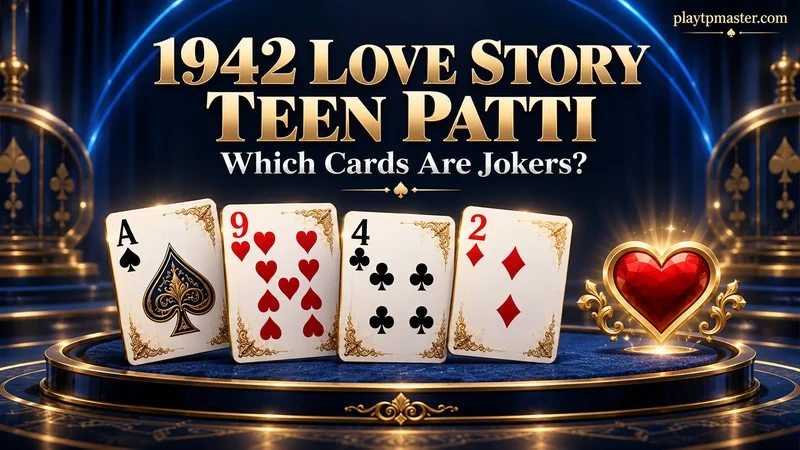
In Octro's published “1942 A Love Story” variation, aces, nines, fours, twos and every heart are jokers. Remembering only A-9-4-2 leaves out part of that documented rule: a 5♥ or K♥ also qualifies, even though its rank is not in the name.
This guide explains that particular wild-card selection rule with original worked examples. It does not establish which modes are available in Teen Patti Master. Check the exact game's help before applying these examples to an app or a different table.
On this page
A quick test: rank OR hearts
Ask two questions about a card. Is its rank A, 9, 4 or 2? If not, is its suit hearts? Under the cited rule, a yes to either question makes the card wild. A card that passes both tests is still one card, not two jokers.
Swipe sideways if the table is wider than your screen.
| Card | Rank test | Hearts test | Wild? |
|---|---|---|---|
| A♠ | Passes | No | Yes |
| 9♦ | Passes | No | Yes |
| 4♣ | Passes | No | Yes |
| 2♠ | Passes | No | Yes |
| 5♥ | Does not pass | Yes | Yes |
| K♥ | Does not pass | Yes | Yes |
| 9♥ | Passes | Yes | Yes, counted once |
| K♣ | Does not pass | No | No |
The test is OR, not AND. Requiring a card to be both one of the four named ranks and a heart would incorrectly exclude A♠ and 9♦. Ignoring hearts would incorrectly exclude 5♥ and K♥.
If your table explicitly lists only the four ranks, follow that posted rule rather than silently adding hearts. This article's results use the broader Octro selection. The comparison below shows why that detail needs checking; it is not a claim that every other version uses a specific alternative.
The hand-evaluation assumptions for our examples
We use three-card hands from a single 52-card deck without printed jokers. Any selected wild card may represent a needed rank and suit. Trail ranks above a same-suit sequence, followed by mixed-suit sequence, colour, pair and high card. Joker-assisted combinations are allowed in these categories, with no extra preference for natural hands.
These evaluation conventions are stated for the worked examples because a short list of wild cards is not a complete table rulebook. In particular, names such as “pure sequence”, natural-hand priority and settlement of tied hands may differ. The source below establishes the selected wild cards; the examples show what follows under the assumptions given here.
Our Joker Teen Patti rules cover the general method. For each hand, mark the wild cards, leave every ordinary card fixed, then find the strongest permitted combination. Do not compare two hands until you have evaluated both using the same convention.
Worked example 1: why the hearts rule changes the winner
Hand A contains K♣ K♦ 5♥. Hand B contains Q♣ Q♦ Q♠. All six physical cards are distinct. Under the cited rule, A's 5♥ is wild and can represent K♠, making a king trail. B is a natural queen trail, so A has the higher trail.
Swipe sideways if the table is wider than your screen.
| Selection used for this comparison | Hand A | Hand B | Stronger hand |
|---|---|---|---|
| A, 9, 4, 2 plus all hearts | King trail | Queen trail | A |
| Hypothetical ranks-only agreement | Pair of kings | Queen trail | B |
The second row is a controlled comparison: we remove the hearts condition and leave every physical card unchanged. It shows why a missing rule detail can reverse the answer. It is not an instruction to switch rules halfway through a round.
Notice that the queen trail contains no hearts. Had B contained Q♥, that card would also need to be evaluated as wild under the first row's rules. Inspect every card rather than stopping after finding a joker in only one hand.
Worked example 2: a joker does not guarantee a trail
Take Q♣ J♣ 2♦. The two is wild and may represent K♣, completing J♣ Q♣ K♣. Under the stated assumptions, this is a same-suit sequence. It cannot become a trail because the ordinary queen and jack have different ranks and must remain unchanged.
Now inspect 10♠ 5♣ 9♦. The nine is wild, but the fixed ten and five cannot fit inside one three-card sequence. They also have different suits. The strongest available category is a pair of tens, with the five as the remaining card. Turning 5♣ into another ten would be an illegal second replacement: it is not wild.
Swipe sideways if the table is wider than your screen.
| Original cards | Wild card | Best result here |
|---|---|---|
| Q♣ J♣ 2♦ | 2♦ | Completed same-suit sequence, using K♣ |
| 10♠ 5♣ 9♦ | 9♦ | Pair of tens, using 10♦ |
| 10♠ 5♥ 9♦ | 5♥ and 9♦ | Ten trail, using 10♣ and 10♦ |
The last row changes the five's suit to hearts. That creates a second joker and allows a trail. Suit recognition therefore matters before classification, not just when deciding whether a sequence is suited.
Worked example 3: all three cards are wild
A♣ 9♦ 4♠ contains three wild cards under the cited selection. With unrestricted substitution and trail at the top of our example ranking, those cards can represent an ace trail. The physical ace is not the only reason: all three cards are available as substitutes.
Another hand containing 2♣ 5♥ K♥ also has three wild cards and can reach the same ace-trail rank under those assumptions. The first hand does not automatically win because it visibly contains an ace. The completed hands have equal strength; use the table's separate tie rule for settlement.
Likewise, a hand with two jokers and one ordinary king can reach a king trail, not an ace trail. The fixed king must stay in the final three-card hand. Read our sequence list if you need a reminder of the order of categories before practising substitutions.
How many wild cards are in a full deck?
For the stated selection and a complete 52-card deck, our count is 25 distinct wild cards. The four named ranks supply 4 × 4 = 16 cards. Hearts supply 13 more, but A♥, 9♥, 4♥ and 2♥ are already included among those sixteen. Subtract the four overlaps: 16 + 13 − 4 = 25.
Swipe sideways if the table is wider than your screen.
| Counting step | Cards |
|---|---|
| All aces, nines, fours and twos | 16 |
| All hearts | 13 |
| Cards included in both groups | Subtract 4 |
| Distinct wild cards | 25 |
| Other cards in the full deck | 27 |
This is a count of eligible cards, not a forecast of how many jokers a player receives. Cards already dealt or removed change what remains available. A large wild-card pool also does not establish a winning strategy or prove that a displayed hand beats every opponent.
Practice: catch the common mistakes
Each row is a separate exercise using the same assumptions. Try the rank-or-hearts test before revealing the answer in the final column.
Swipe sideways if the table is wider than your screen.
| Hand | Number of wild cards | Best category under our assumptions |
|---|---|---|
| 7♣ 7♦ K♥ | One | Seven trail |
| 10♣ J♣ 4♠ | One | Completed same-suit sequence, using Q♣ |
| K♠ 8♦ 3♣ | None | King-high |
| 2♣ 5♥ K♥ | Three | Ace trail |
K♥ is wild because it is a heart, but K♠ is not. A 4♠ qualifies because of its rank even though it is black. Remembering both routes is more reliable than remembering the colour of the cards in a cover illustration.
Common questions and related variations
Is a printed joker required?
Not for the selection described here. Ordinary cards become wild because of their rank or suit. Do not add extra printed jokers to a physical practice deck unless your agreed rules call for them.
Is 1942 the same as 1947?
No. Octro lists 1947 separately with A, 9, 4 and 7 as jokers. Do not carry the two or the hearts condition across just because the names look similar. Read the specific variant's rule.
Does the name change blind, seen or show rules?
A list of joker ranks does not specify those procedures. Confirm them separately in the table's help. This article evaluates completed hands rather than inventing betting limits, fees or a universal tie settlement.
Which variation should I learn next?
The Marriage Joker guide selects neighbouring ranks around an indicator, whereas this guide starts with fixed ranks and a suit condition. The AK47 examples give another fixed-rank comparison. These links stay within Teen Patti learning; they do not imply that all the modes are available in any particular TPM release.