
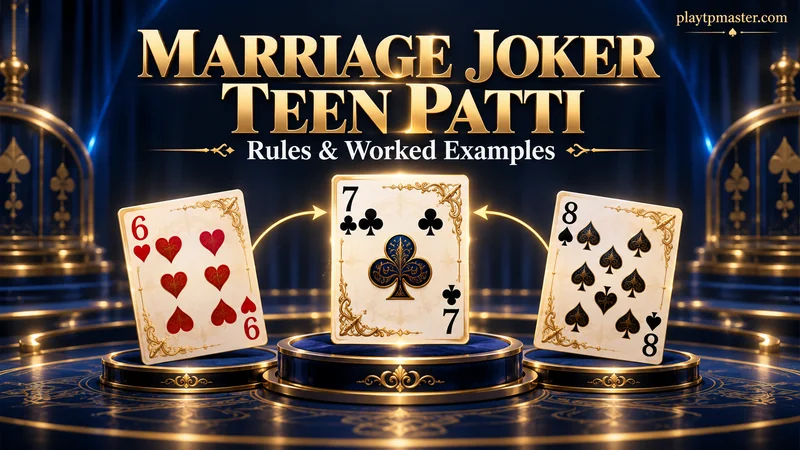
Marriage Joker is a Teen Patti variation in which a selected joker is linked to the ranks immediately above and below it. If the selected rank is 7, the neighbouring ranks are 6 and 8. The important next question is whether those ranks are wild in every suit or only under a narrower suit rule.
Octro's published variation guide describes the selected card and its two neighbours, but its short description does not settle every suit or ace-boundary question. This guide therefore states its example rules explicitly. It teaches a card-game variation; it does not confirm that a particular Teen Patti Master version offers this mode.
On this page
The example rules used on this page
For every worked hand below, the indicator rank is 7 and all sixes, sevens and eights are wild, regardless of suit. We use a single standard deck without printed jokers. A wild card may represent the rank and suit needed for the strongest allowed three-card hand. These are declared teaching assumptions, not a claim about every app's rules.
Swipe sideways if the table is wider than your screen.
| Item | Convention for these examples |
|---|---|
| Selected rank | 7 |
| Wild ranks | 6, 7 and 8 |
| Suit coverage | All four suits |
| Category order | Trail, same-suit sequence, mixed-suit sequence, colour, pair, high card |
| Wild-card combinations | Allowed in the relevant category; no natural-hand preference |
| Equal final hands | Same hand strength; settlement must follow the table's rule |
This separation matters: deciding which cards are wild comes first; deciding what they can represent comes second. An app could display the same three ranks while restricting how a joker completes a hand. Read both parts of its help before applying an example.
Find the jokers before comparing the cards
With 7 as the selected rank, 6♥, 7♣ and 8♠ are all wild under our all-suits convention. A 5♥ is not wild just because it shares a suit with 6♥. A 9♣ is not wild just because it sits next to 8 in the rank order: neighbours are measured from the selected 7, not repeatedly from every new joker.
Swipe sideways if the table is wider than your screen.
| Card to inspect | Wild here? | Reason |
|---|---|---|
| 6♦ | Yes | One rank below 7 |
| 7♠ | Yes | Selected rank |
| 8♥ | Yes | One rank above 7 |
| 5♦ | No | Two ranks below 7 |
| 9♠ | No | Two ranks above 7 |
| K♥ | No | Outside the three selected ranks |
There are twelve cards of ranks 6, 7 and 8 in a full 52-card deck: three ranks multiplied by four suits. That count describes the deck before any indicator is removed. If a physical indicator remains outside play, do not count it as a card that can still be dealt. Nor does twelve mean twelve jokers appear in every round.
Worked example 1: a pair becomes a trail
Hand A is Q♠ Q♦ 6♥. Hand B is K♣ K♦ J♠. First mark the wild cards: only A's 6♥ qualifies. Let it represent Q♥. A now evaluates as three queens, a trail. B remains a pair of kings with a jack alongside it.
Swipe sideways if the table is wider than your screen.
| Hand | Original cards | Best evaluated hand | Result |
|---|---|---|---|
| A | Q♠ Q♦ 6♥ | Q♠ Q♦ Q♥, queen trail | Stronger category |
| B | K♣ K♦ J♠ | Pair of kings | Weaker category |
The kings do not win merely because king ranks above queen. Compare the category before the rank inside that category. This is the same ordering principle explained in our sequence list; the joker changes which category A can reach.
Worked example 2: complete the right sequence
Hand A is J♠ Q♠ 6♦. The 6♦ can represent K♠, producing J♠ Q♠ K♠. Hand B is 9♣ 10♦ J♥, a natural mixed-suit sequence. Under the example rules, A's completed same-suit sequence is stronger than B's mixed-suit sequence.
This page uses the usual category position for a completed same-suit sequence when jokers are permitted. Some interfaces reserve the label “pure” for a natural hand or give natural hands special treatment. Check that convention instead of assuming the word alone settles the result.
The physical 6♦ does not turn the hand into a diamond combination. In our example, its represented suit is spades. Conversely, J♠ Q♦ plus a joker cannot become a same-suit sequence: the two ordinary cards already have different suits, and neither is wild.
Worked example 3: two jokers and one fixed card
Consider K♣ 6♦ 8♥. Both numbered cards are wild, so they can represent K♦ and K♠. The strongest category available is a king trail. The ordinary K♣ remains a king; it cannot become an ace just because the other two cards are wild.
Compare that with A♣ A♦ A♠, a natural ace trail. Under our stated category and rank rules, the ace trail is stronger. Having more jokers does not automatically mean having the best final hand.
With Q♣ 6♠ 8♦, the same method gives a queen trail. Try to name the final three ranks aloud before comparing hands. “Two jokers” describes the resources in the hand; “three queens” describes the combination being compared.
Agree suit, ace and tie conventions in advance
A selected ace or king raises a question that a middle rank such as 7 avoids. Does the neighbour rule wrap around between king, ace and two? Is ace high, low, or treated specially? Our examples deliberately do not invent an answer for a table whose help leaves that unspecified.
Likewise, confirm whether all suits qualify, whether the indicator stays outside the deal, whether jokers may represent any suit, and whether a natural hand beats an otherwise equal joker-assisted hand. Our Joker Teen Patti rules explain why identifying the wild card and comparing the completed hand are separate steps.
For example, Q♠ Q♦ 6♣ and Q♣ Q♥ 8♦ can each evaluate as a queen trail under our assumptions. Neither has a higher trail rank. A rule about who requested a show, a natural-hand preference, or a split result must come from the table; the card pattern alone cannot choose the settlement.
Practice: identify the strongest category
Keep the indicator at 7 and the all-suits convention. Each row is a separate exercise, not several players in the same deal. Decide which cards are wild before reading the answer.
Swipe sideways if the table is wider than your screen.
| Cards | Answer | Explanation |
|---|---|---|
| A♣ A♦ 8♠ | Ace trail | 8♠ can represent A♥ |
| 10♣ J♣ 6♥ | Completed same-suit sequence | 6♥ can represent Q♣ |
| K♣ 5♦ 8♠ | Pair of kings | The fixed K and 5 cannot both fit a three-card sequence or one suit |
| A♣ 10♦ 3♠ | Ace-high | No card is wild and no stronger pattern is present |
For the third row, the joker can pair the king or the five, but the king pair is stronger. It cannot turn 5♦ into a queen, because the five is not wild. This is a useful check against changing too many cards while evaluating a hand.
Common questions and the next variation to learn
Is Marriage Joker the same as Marriage Rummy?
No. This article concerns a three-card Teen Patti variation. Marriage Rummy is a separate game with its own deal, combinations and scoring. Do not import a rummy declaration requirement into these three-card comparisons.
Do 6, 7 and 8 stay wild in every round?
Only if the selected rank remains 7 under the agreed rule. They are the running example here, not permanent wild ranks for every Marriage Joker game. Write down the new indicator before starting another practice round.
Is this a verified TPM app feature?
This article does not make that claim. Use the exact table's rules screen to confirm availability and implementation. The cover is an editorial illustration, not an app screenshot.
What should I read next?
The 1942 Love Story guide uses a fixed set of ranks and a separate hearts condition, making it a useful contrast with Marriage Joker's selected neighbouring ranks. The AK47 examples provide another fixed-rank variation. Practise with cards and non-cash counters; the purpose here is learning how to read hands.