
Use this page to identify and order the six hand categories. For equal-category comparisons and settlement examples, continue to 3 Patti tie-breaks. The main Teen Patti rules guide covers how the round operates.
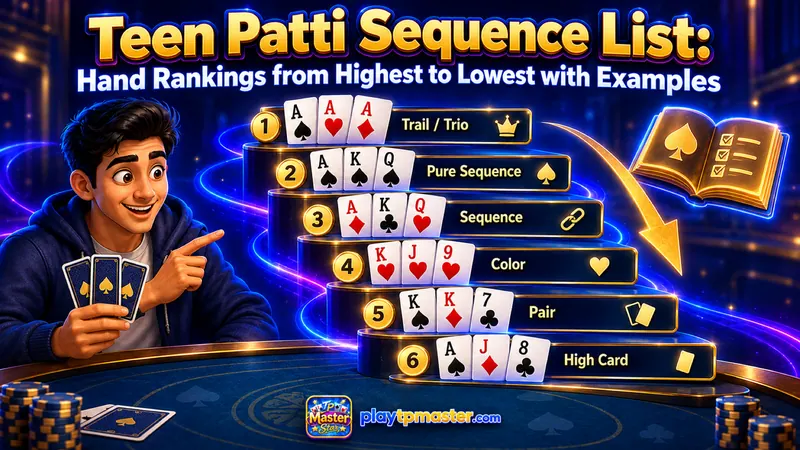
The standard Teen Patti hand order is trail, pure sequence, sequence, colour, pair, and high card. A higher category beats a lower category before individual card ranks are compared. Three aces are the highest ordinary hand in classic Teen Patti without jokers or special winning rules.
People often search for a “Teen Patti sequence list” when they mean the entire hand-ranking chart. Strictly speaking, a sequence is only one type of hand: three consecutive ranks. Keeping those meanings separate helps when reading a table’s instructions or discussing a result with friends.
This guide covers classic three-card rankings. Muflis, joker tables, and other variations need their own rules and should not be evaluated automatically with this chart.
On this page
Complete Teen Patti Hand-Ranking Chart
Swipe sideways to see every column.
| Rank | Category | Meaning | Example |
|---|---|---|---|
| 1 — highest | Trail or trio | Three cards of the same rank | J♣ J♦ J♥ |
| 2 | Pure sequence | Three consecutive ranks in one suit | 7♠ 8♠ 9♠ |
| 3 | Sequence or run | Three consecutive ranks, not all one suit | 7♣ 8♦ 9♥ |
| 4 | Colour or flush | One suit, without a sequence | A♦ J♦ 6♦ |
| 5 | Pair | Two matching ranks and one different rank | 10♣ 10♥ 4♠ |
| 6 — lowest | High card | No category above applies | K♠ 9♥ 3♣ |
Read the chart from top to bottom. The first matching category is the hand’s classification. This prevents a suited sequence from being mistakenly classified as an ordinary colour.
For example, 5♥ 6♥ 7♥ satisfies “all one suit,” but it also satisfies the stronger pure-sequence condition. Its correct category is pure sequence. A hand receives its strongest applicable classification, not whichever description you notice first.
1. Trail: Three Matching Ranks
A trail contains three cards of the same rank, such as 8♣ 8♦ 8♠. Suits differ because an ordinary single deck contains only one copy of each rank-and-suit combination. The trail order follows rank: aces above kings, then queens and the remaining ranks down to twos.
The important beginner lesson is that the category takes priority over attractive individual cards. A trail of twos beats K♥ Q♥ J♥ under classic rankings. The kings, queens, and jacks look high, but they form a lower category.
Do not confuse trail with a pair. In 8♣ 8♦ A♠, only two ranks match. The ace is a kicker; it does not turn the hand into three of a kind or make it equivalent to a trail of aces.
2. Pure Sequence: Consecutive and Suited
A pure sequence needs both conditions at once: consecutive ranks and the same suit. The hand 9♦ 10♦ J♦ qualifies. The hand 9♦ 10♦ Q♦ does not, because the jack is missing.
Among ordinary numbered runs, the higher run wins. Thus 10♣ J♣ Q♣ beats 8♥ 9♥ 10♥. The suit is not what makes the first hand stronger; the rank sequence is.
Ace-containing runs need extra care. Some Teen Patti tables put A-2-3 above A-K-Q; others put A-K-Q above A-2-3, with A-2-3 commonly placed second in that convention. Other implementations can place A-2-3 low. Read the specific ranking chart rather than assuming a poker rule applies.
3. Sequence: Consecutive Ranks Across Suits
A sequence follows the same consecutive-rank requirement but is not all one suit. For example, 4♣ 5♣ 6♥ is a sequence even though two cards share a suit. “Mixed suits” does not require all three suits to be different.
Compare 4♣ 5♣ 6♥ with A♠ J♠ 8♠. The first hand is a sequence; the second is a colour. The sequence wins despite containing lower individual ranks.
Do not allow a gap because the other player’s cards look weaker. The hand 4♣ 5♦ 7♥ is not a sequence, and rearranging its display order cannot change that. Likewise, Q-K-A can be an ace-high run, but K-A-2 is not a normal wraparound sequence.
A Usable Sequence Order—and Its Boundary
The list below adopts an explicitly stated teaching convention: A-2-3 first, followed by A-K-Q. Use it only where the table specifies that convention. Apply the same rank order within pure sequences and within ordinary sequences; a pure sequence remains a higher category than an ordinary sequence.
Swipe sideways to see every column.
| Position | Consecutive ranks |
|---|---|
| 1 | A-2-3 |
| 2 | A-K-Q |
| 3 | K-Q-J |
| 4 | Q-J-10 |
| 5 | J-10-9 |
| 6 | 10-9-8 |
| 7 | 9-8-7 |
| 8 | 8-7-6 |
| 9 | 7-6-5 |
| 10 | 6-5-4 |
| 11 | 5-4-3 |
| 12 | 4-3-2 |
Writing a run backward does not create a new run: 7-8-9 and 9-8-7 describe the same ranks. The table contains twelve rank patterns, not twelve different hand categories. This distinction explains why a page may mention twelve sequences but only six overall categories.
4. Colour: One Suit Without a Run
Colour means suit, not simply red or black. Hearts and diamonds are both red, but A♥ 9♦ 5♥ is not a colour. A♥ 9♥ 5♥ is, because every card is a heart.
When two colours compete, arrange each hand from highest to lowest rank and compare the first unequal card. For A♣ 10♣ 4♣ versus A♦ 9♦ 8♦, the aces match and the ten beats the nine. The four does not need to beat the eight because the comparison has already been decided.
Avoid adding the ranks together. A higher total is not the rule, and doing arithmetic can produce the wrong winner. Colour comparison is ordered, not additive.
5. Pair: Matching Ranks First
A pair contains two cards of one rank and a third card of another rank. Compare the paired ranks before considering the odd card. Consequently, 9♣ 9♦ 2♥ beats 8♣ 8♦ A♠.
If the pairs match, compare the third cards. For example, Q♣ Q♦ 10♥ beats Q♥ Q♠ 7♦. Both players have queens, so the ten is the deciding kicker.
The kicker cannot compensate for a lower pair. Keeping that rule in mind prevents one of the most common errors made by new players who focus immediately on an ace.
6. High Card: No Stronger Pattern
A high-card hand has no pair, no sequence, and no colour. Compare its ranks in descending order, moving to the second and third cards only if needed.
For K♣ 10♥ 6♦ versus K♦ 10♠ 4♥, both the kings and tens match. The six wins the final comparison. Saying that both players “have king-high” is correct but incomplete: the rest of the hand still matters.
Under ordinary suit-neutral comparison, equal rank patterns have equal strength. The table’s show or tie-settlement rule then determines the outcome; do not invent a suit hierarchy to force a winner.
Classification Practice: Spot the Strongest Applicable Category
Try naming each hand before reading its explanation. Assume ordinary rankings and no wild cards.
Swipe sideways to see every column.
| Hand | Correct answer | Why |
|---|---|---|
| 2♠ 3♠ 4♠ | Pure sequence | Consecutive ranks and one suit |
| A♣ A♦ 7♣ | Pair | Only two aces; matching two suits is irrelevant |
| K♥ Q♥ 10♥ | Colour | One suit, but no jack to complete a run |
| 6♣ 7♦ 8♦ | Sequence | Consecutive; a repeated suit does not disqualify it |
| K♠ A♥ 2♦ | High card | The ace does not connect king to two |
The exercise is more useful than memorizing a list without checking its conditions. For every answer, identify why the category fits and why the category immediately above it does not.
What to Confirm Before Using the Chart
Before the first deal, establish whether the game uses classic rankings, which ace convention applies, whether jokers are active, and how equal hands are settled. Those four details prevent most disagreements that a generic sequence list cannot resolve.
Practise classification with face-up cards and non-cash counters before adding blind play or changing stakes. A high-ranked hand is not a guarantee of winning every round, and remembering the chart does not make an unverified app safe. Use the list to understand results—not as a promise of earnings or a reason to keep playing beyond a planned limit.