
This comparison covers 13-card Indian rummy and Texas Hold’em. For three-card play rather than poker, see Teen Patti vs Rummy.
Rummy is about building a valid arrangement of cards. Poker is about contesting a pot through betting decisions and, when necessary, comparing ranked hands. In rummy, a low sequence can be exactly what you need to finish. In poker, merely holding a valid combination does not mean that it beats an opponent’s combination.
Both names describe families of games. To keep this comparison useful, “rummy” here means 13-card Indian rummy, while “poker” means standard high-hand Texas Hold’em. Gin rummy, Omaha, lowball poker, and other variants have different requirements. These rules explain the games; they do not confirm which modes a particular app currently offers.
On this page
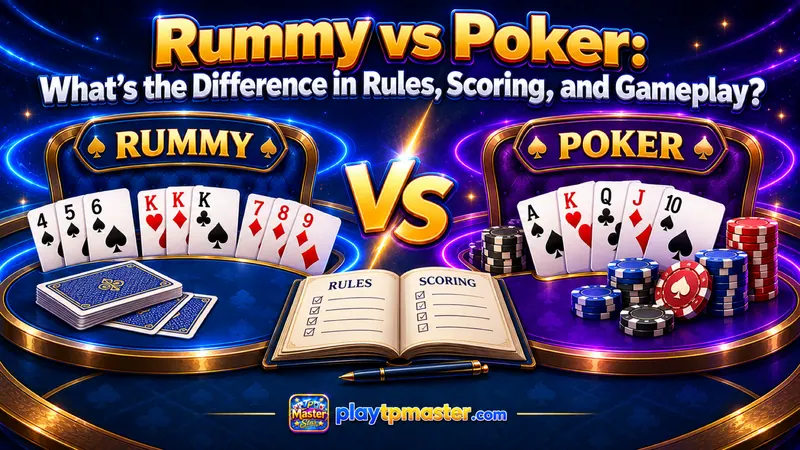
Rummy vs Poker at a Glance
Swipe sideways to see every column.
| Feature | 13-card Indian rummy | Texas Hold’em poker |
|---|---|---|
| Starting private cards | Thirteen | Two |
| Shared cards | No shared board used to complete everyone’s hand | Up to five community cards |
| Main turn activity | Draw and discard | Check, bet, call, raise, or fold when permitted |
| Final objective | Complete a valid declaration | Win the pot uncontested or with the strongest eligible hand |
| Cards evaluated | All thirteen must fit the declaration requirements | Best five from the seven available cards |
| Role of points | Usually penalty scoring within the selected format | Chips track the pot and stacks; card ranks are not added |
| Role of jokers | Often permitted under defined rules | Not part of standard Hold’em |
The most important row is the final objective. Rummy asks whether your arrangement meets the required structure. Poker asks whether your hand is stronger than competing hands, unless everyone else folds first.
How a Rummy Hand Develops
A player starts with thirteen cards and works toward sequences and sets. On an ordinary turn, the player draws from the closed deck or permitted open discard pile, then discards a card. The temporary fourteen-card holding returns to thirteen.
In the common format used here, a valid declaration needs at least two sequences, including one pure sequence. The remaining cards must also belong to permitted groups. A pure sequence contains consecutive cards of one suit without a joker substituting for a missing card. A set uses matching ranks in different suits.
The practical challenge is arranging overlapping possibilities. A card might help a sequence or a set, but it cannot count in both groups at once. Your layout must account for every physical card exactly once.
Worked Example: Turning Thirteen Cards into a Declaration
Assume none of the listed cards is designated wild. Start with:
Swipe sideways to see every column.
| Group | Cards | Position before drawing |
|---|---|---|
| A | 4♥ 5♥ 6♥ | Complete pure sequence |
| B | 8♣ 9♣ 10♣ J♣ | Complete pure sequence |
| C | Q♠ Q♥ Q♦ | Complete set |
| D | 2♦ 3♦ | Incomplete sequence |
| Loose card | K♠ | Not grouped |
There are thirteen cards: 3 + 4 + 3 + 2 + 1. Drawing 4♦ supplies the missing card for Group D. After discarding K♠, the arrangement contains thirteen cards in four valid groups.
Drawing 4♠ would not produce the same result. Its rank is useful, but its suit does not complete 2♦-3♦-4♦. A mixed-suit run is not a natural rummy sequence. The example also shows why a lower card may be more useful than a king: usefulness depends on the structure, not just rank.
How a Hold’em Hand Develops
Each player receives two private hole cards. Betting begins before the flop, then continues after the three-card flop, the one-card turn, and the one-card river, unless the hand finishes earlier. The shared board ultimately contains five cards.
At showdown, a player uses the strongest five-card combination available from the two hole cards and five community cards. Both, one, or neither hole card may be used. There is no rummy-style requirement to place every available card into a group.
The ordinary ranking runs from straight flush down through four of a kind, full house, flush, straight, three of a kind, two pair, one pair, and high card. A royal flush is the highest straight flush, not a different method of scoring points.
Worked Example: Which Cards Actually Play?
Suppose the board is A♣ A♦ 8♠ 5♥ 2♣. Mina holds K♠ Q♠, while Dev holds K♥ J♥. Neither has a flush or straight. Both use the two aces on the board and their king, but their next kickers differ.
Mina’s best five are A-A-K-Q-8. Dev’s are A-A-K-J-8. Mina wins because the queen outranks the jack at the first unequal comparison. The unused five and two do not add points, and the suits do not break the tie.
Now change the board to A♣ K♦ Q♥ J♠ 10♣. Give Mina 7♦ 6♦ and Dev 9♥ 8♥. Both play the board’s ace-high straight. Neither player can introduce a sixth card to win; their identical best five-card hands tie.
Scoring: Penalty Points Are Not Poker Hand Strength
Common Indian rummy scoring assigns ten points to aces and face cards, face value to numbered cards, and zero to jokers. A valid winner normally receives zero penalty points. Losing-hand calculations depend on the format, including whether required sequences are present, which groups qualify for protection, and any penalty cap.
For a simplified example, assume a losing hand already meets the required sequence conditions and its only ungrouped cards are K♦, 8♠, and 3♥. If the selected rules count those unmatched cards, the penalty is 10 + 8 + 3 = 21. This is not a universal calculation for a hand lacking the compulsory sequences.
Poker does not add card values this way. A king and an eight do not create eighteen points, and a higher total of printed ranks does not win. Hand category comes first, followed by the category’s tie-break rules.
Pot Size and Profit Are Different Numbers
Consider a fictional no-fee practice hand with three players. One contributes twelve chips, another twelve, and the third six before folding. The pot is thirty chips. If the first player wins it, thirty chips are returned to that player, but the net gain is eighteen after subtracting the twelve already contributed.
The example separates the award from the change in the stack. Tournament chips are also not automatically cash: finishing positions and any prizes follow the tournament’s own rules. Do not compare a poker pot with rummy penalty points as if they measure the same thing.
Information and Decisions Feel Different
Rummy makes card organization an ongoing task. A visible discard can reveal something about another player’s choices, but it does not reveal the entire hand. You still need to decide which unfinished groups are worth keeping and whether a new draw genuinely improves your arrangement.
Hold’em adds shared information as the board develops. A promising starting hand can become weak relative to that board. Bets also create decisions about the cost of continuing, but a large bet is not proof of a strong hand, and a quiet opponent is not proof of weakness.
Neither game becomes predictable because a player recognizes a pattern in a few rounds. Understanding the rules helps you interpret decisions and results; it does not guarantee future cards or winnings.
Mistakes When Moving Between the Games
The first common mistake is treating every run as equivalent. In rummy, natural sequences require one suit. In Hold’em, a straight can use mixed suits; a same-suit straight belongs to the stronger straight-flush category.
The second is trying to use every poker card. Hold’em selects five cards and ignores the rest. Rummy’s declaration instead needs to account for all thirteen cards, so an ungrouped leftover cannot simply be excluded.
The third is assuming that three matching cards always outrank a run. Standard five-card poker ranks a straight above three of a kind. A rummy set is not competing against a sequence for rank at all: each group serves the declaration requirements.
A Useful Way to Practise Both
Use a physical deck and non-cash counters. For rummy, explain why each card belongs in its proposed group, then test whether one draw and discard completes the hand. For Hold’em, lay out a board and two pairs of hole cards, identify each player’s exact best five, and explain the first difference.
Only add scoring and betting procedures once those comparisons are comfortable. Agree the format, stopping time, and limits in advance. Choose practice that requires no payment, and do not treat either game as an income plan. The best beginner benchmark is being able to explain a result correctly—not winning several hands in a row.