
This guide focuses on card counts and the meaning of “13 Patti.” For a broader beginner comparison, see Teen Patti vs Rummy.
On this page
What Is the Difference Between 13 Patti and 3 Patti?
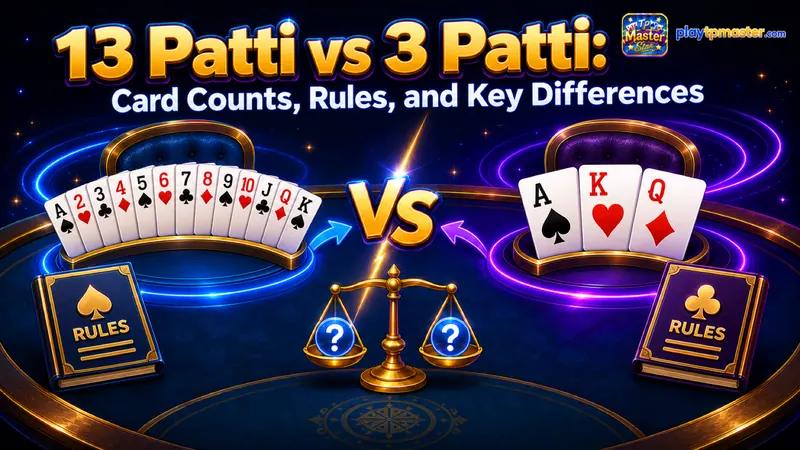
The main difference is what players do with their cards. In searches about Indian card games, “13 Patti” often refers informally to 13-card rummy. Players draw and discard cards to build valid sequences and sets. “3 Patti” usually means Teen Patti, where players receive three cards and continue, fold or compare hands according to the table rules.
However, 13 Patti is not one universally standardized game title. A particular app may use the phrase differently. This comparison uses the common interpretation of 13-card Indian rummy and standard three-card Teen Patti. If your app deals thirteen cards but asks you to arrange poker-style hands, this rummy explanation may not apply.
Neither format becomes a different game simply because an app adds “Master,” “Gold” or another marketing word to its name. Check the selected mode and its rules before using a guide.
13 Patti vs 3 Patti at a Glance
Swipe sideways to see every column.
| Feature | 13-card Indian rummy | Standard Teen Patti |
|---|---|---|
| Starting hand | Thirteen cards | Three cards |
| Main objective | Complete a valid arrangement | Win through hand comparison or opponents folding |
| Normal turn | Draw, then discard | Continue, raise where allowed, or pack |
| Card replacement | Part of normal play | Normally no drawing or discarding |
| Main combinations | Sequences and sets | Trail, Pure Sequence, Sequence, Colour, Pair, High Card |
| Jokers | Often included under specified rules | Usually absent from classic play |
| Winning finish | Valid declaration | Last player remaining or winning Show |
| Scoring | Depends on Points, Pool or Deals format | Pot awarded under the table rules |
How a 13-Card Rummy Round Works
Players receive thirteen cards. A closed draw pile and an open discard pile provide the available draws. On a normal turn, a player takes one card and discards one, working toward an arrangement that satisfies the declaration requirements.
In a common Indian rummy format, all thirteen cards must belong to valid groups, including at least two sequences and at least one pure sequence. A sequence contains consecutive ranks of one suit. A set contains cards of the same rank in different suits.
The second sequence does not have to be impure. Two pure sequences can meet the minimum sequence requirement. Players also do not necessarily need a set if the entire hand can be legally arranged into sequences. These principles are illustrated in the operator's 13-card declaration reference.
Worked Example: A Complete Thirteen-Card Arrangement
Assume ordinary sequence and set rules, with no wild rank affecting the example. The player finishes with these groups:
Swipe sideways to see every column.
| Group | Cards | Why it qualifies |
|---|---|---|
| First sequence | 4♥, 5♥, 6♥ | Three consecutive hearts |
| Second sequence | 9♣, 10♣, J♣ | Three consecutive clubs |
| Set | 7♠, 7♥, 7♦ | Three sevens in different suits |
| Third sequence | A♦, 2♦, 3♦, 4♦ | Four consecutive diamonds using Ace low |
The count is 3 + 3 + 3 + 4 = 13. Every card belongs to one group. There are three pure sequences, so the hand meets the common minimum of two sequences including one pure sequence.
Now replace 5♥ with K♣ without changing the other groups. The first group no longer forms a sequence, and those remaining cards are not fully arranged. The attractive groups elsewhere do not make the whole declaration valid.
This is why rummy players evaluate the complete thirteen-card structure rather than simply looking for their strongest three cards.
How a Standard Teen Patti Round Works
In Teen Patti, each player contributes an agreed opening amount called the boot. The dealer gives each player three face-down cards. Players then act in the agreed order, commonly clockwise from the dealer's left.
A player can remain blind by not viewing the cards or become seen after looking. Blind and seen players commonly face different continuation amounts. The exact minimum, maximum and increase rules must be read from the table.
Packing means leaving the current round and giving up any contribution already placed in its pot. When everyone except one player packs, the remaining player wins without needing the strongest actual hand. When two players remain, an eligible Show compares their cards.
There is normally no opportunity to discard a weak card and draw a replacement. That difference changes the entire decision process compared with rummy.
Teen Patti Hand Rankings Explained
Swipe sideways to see every column.
| Rank | Category | Example |
|---|---|---|
| 1 | Trail or Trio | Q♠, Q♥, Q♦ |
| 2 | Pure Sequence | 8♣, 9♣, 10♣ |
| 3 | Sequence | 5♠, 6♥, 7♦ |
| 4 | Colour | A♥, J♥, 8♥ |
| 5 | Pair | 9♠, 9♦, K♣ |
| 6 | High Card | A♠, J♦, 8♣ |
Compare the category before comparing ranks within it. A low Sequence beats a high Pair under this standard hierarchy. The relative ordering of A-2-3 and A-K-Q varies between rule sets, so confirm it separately.
A same-suit run belongs to Pure Sequence rather than ordinary Colour. This prevents counting one hand as several categories and selecting the wrong comparison rule.
The Word “Sequence” Means Different Things
In rummy, an ordinary sequence requires the same suit. A mixed-suit 5♠, 6♥, 7♦ does not become a valid rummy sequence simply because its ranks are consecutive.
In Teen Patti, that exact mixed-suit hand is an ordinary Sequence. If all three cards were spades, it would become a Pure Sequence and move into a higher category.
Likewise, three Queens can form a rummy set, but that set alone does not win a thirteen-card game. In Teen Patti, three Queens are a complete three-card Trail.
These vocabulary differences are a frequent source of confusion for people learning both games through one app library.
Jokers and Special Variations
Rummy may use printed jokers and a selected wild rank. A joker can complete an impure sequence or set where permitted. A pure sequence cannot depend on a joker substituting for a missing card; treatment of a designated wild card used at its natural rank should follow the chosen rules.
Classic Teen Patti commonly uses a regular deck without wild cards. Named variations can change that. In a typical AK47 game, aces, kings, fours and sevens act as wild cards. In Muflis, lower hands are favored under the variation's comparison rules.
Do not transfer a joker rule from one game to the other. Even similarly named variations can have different substitution or tie procedures.
Scoring and Pace
Rummy scoring depends on the format. Points Rummy evaluates a deal, Deals Rummy covers a specified series, and Pool Rummy uses a cumulative scoring structure. Exact penalties and elimination limits belong to the selected rules.
Teen Patti usually builds a pot from the boot and later contributions. Winning the pot is different from receiving the same number as net profit because some of those chips were the winner's own contributions.
Three cards make Teen Patti quicker to inspect, but a round can still last several betting cycles. Rummy requires more card organization, although an early valid declaration can end a deal quickly. Neither game has one universal session length.
Which Format Should a Beginner Learn First?
Choose according to the activity you enjoy. Rummy suits players who want to organize cards, evaluate draws and plan possible combinations. Teen Patti suits players who want a smaller hand, simple category comparisons and decisions about continuing or folding.
For a first lesson, use practice play or counters with no monetary value. Learn one standard format before introducing wild cards or special scoring. Understanding one rule set thoroughly is more useful than memorizing several app labels.
Frequently Asked Questions
Is 13 Patti the same as rummy?
It often refers to thirteen-card rummy in informal searches, but the name alone is not definitive. Check the actual objective and turn structure.
Can I draw a card in 3 Patti?
Not in ordinary classic Teen Patti. Drawing and discarding are normal rummy actions, while standard Teen Patti evaluates the original three-card hand.
Does a Pure Sequence automatically win in rummy?
No. The entire thirteen-card hand must satisfy the declaration rules. One valid group does not make the remaining cards valid.
Which game guarantees better results?
Neither. Both involve random card distribution, and learning the rules does not guarantee winning outcomes.
Conclusion
The practical difference between 13 Patti and 3 Patti is arrangement versus three-card comparison. Under the common rummy interpretation, players build valid groups through draws and discards. In Teen Patti, players decide how to act on a fixed three-card hand.
Check the mode, sequence definitions, joker treatment and scoring before playing. If an app uses “13 Patti” for a different format, use that format's rules instead.
Risk note: Use time and spending limits. Virtual chips are not automatically cash, and neither game should be treated as guaranteed income.