

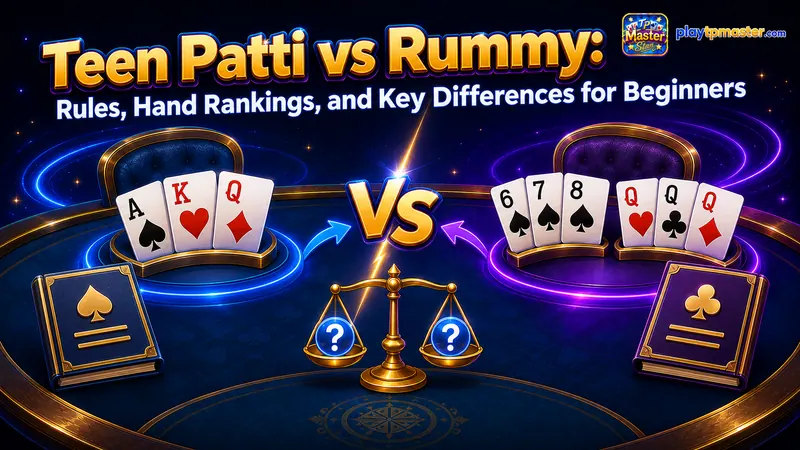
Teen Patti and Rummy both use playing cards, but they ask players to do different things. In classic Teen Patti, you compare a fixed three-card hand while deciding whether to continue or fold. In Indian Rummy, you draw and discard cards to organise a larger hand into valid sequences and sets.
That difference explains why a strong combination in one game may be insufficient in the other. Three aces form the highest trail in classic Teen Patti. In 13-card Rummy, three aces are only one possible set within a hand that still needs other valid groups.
This guide compares classic Teen Patti with common 13-card Indian Rummy. Rummy is a wider family of games, so these declaration requirements should not be applied automatically to Gin Rummy, 21-card Rummy or other formats.
On this page
Teen Patti vs Rummy at a Glance
Swipe sideways to see every column.
| Feature | Classic Teen Patti | Common 13-card Indian Rummy |
|---|---|---|
| Cards initially held | Three | Thirteen |
| Main objective | Remain active and win by comparison or opponents folding | Complete a valid declaration |
| Changes to the hand | Normally no drawing or replacement | Draw and discard during turns |
| Main combinations | Trail, pure sequence, sequence, colour, pair and high card | Sequences and sets |
| Pure sequence | A strong three-card category | Commonly required for a valid declaration |
| Pair | A recognised hand category | Usually an incomplete group |
| Jokers | Absent from the classic version | Commonly used, subject to restrictions |
| Blind play | Available under many rulesets | Not part of the ordinary draw-and-discard process |
| Winning comparison | Higher-ranked hand wins | Validity and format-specific scoring determine results |
| Beginner focus | Categories, contribution costs and folding | Grouping, useful draws and declaration checks |
The terms can overlap, but their functions differ. Learning the vocabulary without learning the objective can create avoidable mistakes.
How a Teen Patti Hand Works
Players receive three face-down cards after contributing the agreed boot amount to a central pot.
On their turns, players may continue under the table’s contribution rules or fold. A blind player has not looked at their cards; a seen player has examined them.
The hand can end when everyone except one player folds. Alternatively, eligible remaining players compare their hands through a show. Some tables also use a pot limit that triggers a comparison.
The important point is that your classic Teen Patti cards remain fixed. You do not draw a fourth card to complete a run or exchange an inconvenient card for a better one.
Published Teen Patti rules describe the three-card deal, blind and seen decisions, and six-category ranking structure. Exact betting and show conditions still depend on the table. Octro’s Teen Patti rules.
How a 13-Card Rummy Hand Works
In the Indian Rummy format used here, each player begins with thirteen cards. Players take turns drawing and discarding to improve their grouping.
The objective is to arrange the final thirteen cards into permitted sequences and sets. A common declaration requirement is at least two sequences, including at least one pure sequence.
The remaining cards must also belong to valid groups. Completing the required sequences does not allow you to leave an unmatched card outside them.
RummyCircle’s published rules describe this grouping requirement and distinguish pure sequences, impure sequences and sets. Indian Rummy rules and declaration requirements.
Check the specific format before playing. Deck count, joker handling, penalties and the process for submitting a declaration can vary.
Teen Patti Hand Rankings Explained
Classic Teen Patti compares complete three-card hands in the following order.
Swipe sideways to see every column.
| Rank | Hand | Example | Explanation |
|---|---|---|---|
| 1 | Trail | Q♣–Q♦–Q♥ | Three cards of the same rank |
| 2 | Pure sequence | 7♠–8♠–9♠ | Consecutive ranks in one suit |
| 3 | Sequence | 7♣–8♦–9♥ | Consecutive ranks with mixed suits |
| 4 | Colour | A♥–10♥–4♥ | Same suit without a sequence |
| 5 | Pair | J♣–J♦–3♠ | Two cards of the same rank |
| 6 | High card | K♣–9♦–2♥ | None of the stronger combinations |
Category comes before individual card rank. A sequence containing small cards beats an ace-high colour. A pair of twos beats an ordinary ace-high hand.
When categories match, use the relevant comparison. Compare paired ranks before kickers, and compare high-card hands from the highest card downward.
The treatment of A–2–3 against A–K–Q should be checked separately because sequence orders can differ.
Rummy Does Not Use the Same Six-Level Hierarchy
Rummy evaluates whether your groups satisfy its rules. You do not normally beat another player’s valid declaration by showing a higher pair or a higher colour.
A pure sequence such as 4♥–5♥–6♥ is a valid run. An impure sequence such as 9♣–PJ–J♣ uses a printed joker to represent 10♣.
A set such as 8♣–8♦–8♥ groups matching ranks in different suits.
By contrast, A♠–J♠–6♠ is not a sequence because the ranks have gaps. Its same-suit structure makes it a colour in Teen Patti, but that category does not turn it into a valid Rummy group.
This is one of the most useful differences for beginners to remember: matching suits alone can form a Teen Patti category, while a Rummy sequence also requires consecutive ranks.
Worked Example: The Same Cards in Both Games
Consider K♣–K♦–K♥.
In classic Teen Patti, the three cards form a trail of kings. That is a powerful complete hand, losing to a trail of aces under ordinary trail ranking.
In Rummy, the same cards can form a set of kings. However, they account for only three of the thirteen cards. You still need the required sequences and valid arrangements for the remaining cards.
Now consider 5♣–6♦–7♥.
In Teen Patti, the cards form a sequence because suits do not need to match for that category.
In Rummy, the group is not a natural sequence. The different suits prevent it from qualifying, unless a card has a permitted wild role that changes the evaluation.
A familiar name therefore does not guarantee an identical rule.
A Complete Rummy Declaration Example
Assume no wild-rank substitutions affect these cards.
Swipe sideways to see every column.
| Group | Cards | Classification | Count |
|---|---|---|---|
| 1 | 3♥–4♥–5♥ | Pure sequence | 3 |
| 2 | 7♣–8♣–9♣–10♣ | Pure sequence | 4 |
| 3 | Q♣–Q♦–Q♥ | Set | 3 |
| 4 | 2♣–2♦–2♠ | Set | 3 |
| Total | Every card used once | Complete grouping | 13 |
This hand has two sequences, both pure, and two sets.
The queen set does not outrank the two set for the purpose of making the declaration valid. Both perform the same structural role: they account for cards in permitted groups.
Two pure sequences can satisfy the sequence requirement. An impure sequence is not compulsory merely because jokers are available.
Drawing Changes the Decisions You Make
Suppose you hold 6♥–7♥ in Rummy. A suitable five or eight of hearts could help complete a natural sequence.
You therefore have a reason to evaluate future draws and the visible discard pile. However, you cannot assume the needed card will become available.
In classic Teen Patti, holding 6♥–7♥–Q♣ creates no comparable drawing opportunity. The queen will not be replaced through ordinary play.
This difference affects beginner advice. “Wait for a connecting card” can describe a Rummy consideration, but it is inappropriate for a fixed classic Teen Patti hand.
Jokers Have Different Roles
Classic Teen Patti normally excludes printed jokers. Joker, AK47 and other variations introduce their own wild-card rules.
In those modes, wild cards help form the strongest three-card category.
Indian Rummy commonly uses printed or designated wild jokers to complete groups. However, a substitute joker does not normally satisfy the pure-sequence requirement.
Some Rummy rules permit a designated wild-rank card to be used naturally in its printed position within a pure sequence. That exception requires careful checking.
Do not assume that learning one game’s joker rule explains every other game using the word “joker.”
Folding and Dropping Are Different Decisions
In Teen Patti, folding removes you from the current hand and leaves earlier contributions in the pot.
In Rummy, a drop may carry a defined penalty that depends on the format and when the player leaves. It is not simply the same action under another name.
Similarly, an invalid Rummy declaration may receive a penalty even if much of the hand was grouped correctly.
Before playing either game, understand the cost of leaving and the conditions for finishing. Do not rely on a penalty figure copied from another app or format.
Which Game Is Easier for Beginners?
Teen Patti usually has fewer cards to inspect, so its basic categories can be learned quickly. The difficulty lies in contribution decisions, hidden information and table-specific rules.
Rummy requires more visual organisation. Beginners must track several groups, identify useful connections and check an entire declaration.
If you enjoy arranging and revising combinations, Rummy may feel more intuitive. If you prefer short three-card comparisons, Teen Patti may be easier to start.
Neither preference establishes a reliable income opportunity. Both involve uncertainty, and familiarity does not remove financial risk where money is involved.
Frequently Asked Questions
Is Teen Patti a type of Rummy?
No. They are different games, even when one application offers both.
Does a pure sequence mean the same thing in both?
Both involve consecutive cards of one suit, but their roles differ. It is a ranked Teen Patti hand and a required type of group in common Indian Rummy.
Is a pair useful in Rummy?
It can be a starting point for a set, but it is generally incomplete under the rules described here.
Can I use a Teen Patti ranking chart for Rummy?
No. Use a Rummy grouping and declaration guide.
What is the safest way to learn?
Use a physical deck or non-redeemable practice chips, agree on the rules and review examples without financial stakes. Set a session limit and avoid chasing losses or treating either game as dependable income.
Review cycle: every 90 days.