
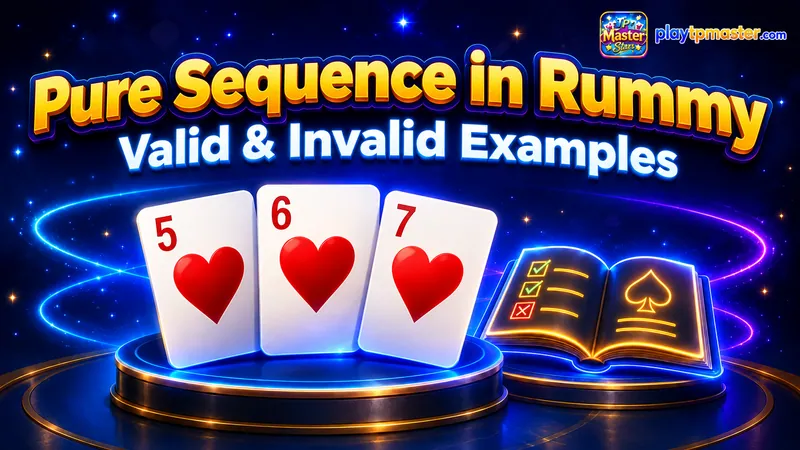
A pure sequence in Indian Rummy is a run of at least three consecutive cards of one suit, with no joker substituting for a missing card. For example, 4♥–5♥–6♥ is pure; 4♥–Joker–6♥ is impure. A pure sequence is necessary for a valid declaration, but it does not complete the entire thirteen-card hand by itself.
This guide uses common 13-card Indian Rummy conventions. The examples are original teaching hands, not screenshots or evidence of a particular app's behaviour. Use physical cards or free practice points, and check the selected format's rules before applying any platform-specific exception.
On this page
The four checks for a pure sequence
Read the cards as a group rather than judging them one at a time. Check length, suit, consecutive ranks and substitution. All four must pass. A red heart and a red diamond share a colour, but they are different suits. A pair of identical cards from two decks does not supply the next rank in a run.
Swipe the table sideways to see all columns.
| Check | Passing example | What fails |
|---|---|---|
| At least three cards | 4♥–5♥–6♥ | 4♥–5♥ alone |
| One suit | 8♣–9♣–10♣ | 8♣–9♠–10♣ |
| No gaps or repeated ranks | 9♦–10♦–J♦ | 9♦–J♦–Q♦ |
| No joker substitution | 2♠–3♠–4♠ | 2♠–Joker–4♠ |
RummyCircle's rules overview describes the basic sequence and declaration requirements. Its introductory wording excludes jokers from pure sequences. A separate natural-use convention exists in some published rules; the joker section below distinguishes that case instead of treating it as universal.
Valid and invalid examples you can check
For this table, none of the numbered cards is designated wild. “Invalid” means invalid as a pure sequence; a group may still serve another purpose in the hand.
Swipe the table sideways to see all columns.
| Cards | Classification | Explanation |
|---|---|---|
| 4♥–5♥–6♥ | Pure | Three consecutive hearts |
| 8♣–9♣–10♣–J♣ | Pure | Four-card runs are allowed |
| A♦–2♦–3♦ | Pure under ace-low rules | Ace occupies the low end |
| Q♠–K♠–A♠ | Pure where ace-high runs are allowed | Ace occupies the high end |
| K♥–A♥–2♥ | Invalid run | The ranks do not wrap around |
| 4♥–5♦–6♥ | Invalid run | Diamonds interrupt the heart suit |
| 4♥–6♥–7♥ | Incomplete run | The five is missing |
| 9♣–9♣–10♣ | Invalid run | A second nine does not replace a jack |
| 4♥–Joker–6♥ | Impure | Joker represents 5♥ |
| 8♠–8♥–8♦ | Set | Same rank across different suits |
Sorting changes the display, not the cards. If the app shows 6♥–4♥–5♥, arrange them as 4♥–5♥–6♥ and the sequence is still valid. Conversely, rearranging K♥–A♥–2♥ cannot repair the wraparound. A gap needs a genuinely missing card or, in an impure group, an allowed substitute.
A wild-rank card used naturally is a special case
A printed joker has no natural numbered position in a suited run. Using one between 4♥ and 6♥ means substitution, so that run is impure.
A wild-rank card is an ordinary card whose rank has been designated wild for the deal. Suppose fives are wild. In 4♥–5♥–6♥, the 5♥ can still be read as its actual printed identity. Some rules accept this as a pure sequence. In 4♥–5♣–6♥, however, the club must stand for 5♥; this is substitution and the run is impure.
Taj Rummy’s published Points rules explicitly allow a wild card to serve at its own printed identity in a pure sequence. This documents one platform’s rule, not a universal exception. Because published rule summaries differ, confirm the table’s treatment before relying on it. If the rule is unclear, practise with a pure run that contains no designated wild rank.
Swipe the table sideways to see all columns.
| Fives are wild | What the five represents | Treatment |
|---|---|---|
| 4♥–5♥–6♥ | Its own rank and suit | Pure only if natural use is accepted |
| 4♥–5♣–6♥ | The missing 5♥ | Impure |
| 8♦–5♥–10♦ | The missing 9♦ | Impure |
The useful question is not simply “Is that rank wild?” It is “Is this exact card playing itself, and does the table allow that natural use?” Never silently apply the exception from one app to another.
One pure sequence is only the first checkpoint
Consider this complete practice hand. Assume sixes are wild but no six appears, and PJ means printed joker:
Pure: 3♥ · 4♥ · 5♥
Impure: 8♣ · PJ · 10♣
Set: K♠ · K♥ · K♦
Pure: 2♦ · 3♦ · 4♦ · 5♦
Count the cards: 3 + 3 + 3 + 4 = 13. PJ represents 9♣. There are three sequences in total, including two pure ones, and the kings form a set. Each physical card appears in exactly one group. This meets the grouping conditions used here.
Now replace 5♥ with 7♠. The first group becomes 3♥–4♥–7♠ and is invalid. The diamond run still supplies a pure sequence and the club run still supplies another sequence, but three cards remain ungrouped. Having the required sequences does not excuse leftover cards. The complete thirteen-card walkthrough follows a draw, discard and declaration check in detail.
Build a practice exercise around the missing card
Place 6♠ and 7♠ beside each other. A natural 5♠ or 8♠ can extend them into a three-card run. A 5♥ cannot: rank alone is insufficient. Now compare 6♠ and 8♠. A natural 7♠ completes the three-card run, while a 5♠ still leaves a gap.
This exercise identifies possible completions; it does not calculate the chance of receiving one. The number of decks, visible discards, cards already held and opponents' hidden cards all affect what remains available. Do not label a hand “certain to complete” just because it has two potential ranks.
When sorting a full hand, avoid using one card twice. If 7♣ appears in both a tentative club sequence and a tentative set of sevens, move it to one group and reassess the other. A neat screen arrangement is not proof of a valid declaration.
Quick self-check
Try answering before opening the explanations. Assume no wild rank unless the question specifies one.
1. Is 10♦–J♦–Q♦–K♦ pure?
Yes. It is a four-card consecutive run in diamonds with no substitution. A pure sequence is not restricted to exactly three cards.
2. Is 7♥–8♦–9♥ a pure sequence?
No. The middle card has the wrong suit. Consecutive ranks alone are insufficient in Rummy.
3. Can 5♣ act as the natural five in 4♥–5♣–6♥ when fives are wild?
No. It must substitute for 5♥ because its printed suit is clubs. The resulting run is impure.
4. Does one pure run plus three sets always make a valid hand?
No. A second sequence is required under the rules used here, and every one of the thirteen cards must belong to a valid group.
Rummy pure sequence versus Teen Patti pure sequence
In Rummy, sequences help organise a thirteen-card hand; several groups coexist and a draw changes the cards you hold. In classic Teen Patti, a pure sequence is a category of a fixed three-card hand, compared against another hand. A four-card run can be one Rummy group but is not a classic three-card Teen Patti hand.
Do not import Teen Patti's A-2-3 versus A-K-Q ranking into a Rummy declaration. Here the question is whether a group is legal, not which of those two completed groups defeats the other. See 13 Patti versus 3 Patti for the wider distinction.
Frequently asked questions
Can a pure sequence contain four cards?
Yes. A consecutive four-card run of one suit can be pure when it uses no substitute and follows the table's ace and wild-card rules.
Is a printed joker allowed in a pure sequence?
No. A printed joker filling a rank makes the sequence impure.
Can the designated wild rank ever appear in a pure sequence?
Some rules allow the exact card to act at its printed rank and suit. A card substituting for another rank or suit still makes the sequence impure. Confirm the table's rule.
Are hearts and diamonds interchangeable because both are red?
No. They are different suits. Colour alone does not satisfy a Rummy sequence.
Does a pure sequence guarantee a valid declaration?
No. You also need at least one more sequence and valid grouping of all thirteen cards, without reusing a card.
Sources and scope
The basic grouping requirements were checked against RummyCircle's rules and its declaration reference chart. The natural wild-card convention is separately identified above. All practice hands and explanations of their outcomes are original editorial examples. This is a rules lesson, not an endorsement of any app or cash-game offer.