
To calculate rummy penalty points, identify which cards must be counted before adding their values. A neat set is not automatically protected from scoring. Your sequence status determines which groups can be excluded.
The examples below follow the published Points Rummy scoring branch used by RummyCircle: with one pure sequence but no second sequence, exclude only the pure sequence. Taj Rummy describes the same branch. These are free practice calculations, not money amounts or a statement of every platform’s rules.
On this page
Card values and the order of checks
| Card or situation | Practice scoring rule |
|---|---|
| 2–10 | Printed number |
| J, Q, K, A | 10 each |
| Printed or designated wild joker | 0 |
| No pure sequence | Count every card, then apply the cap |
| Pure sequence but no second sequence | Exclude the pure sequence only |
| At least two sequences including a pure one | Count cards outside eligible sets and sequences |
| Normal losing-hand maximum in this ruleset | 80 points |
First identify the round’s wild rank. Then check the hand for a pure sequence and a second sequence. Mark the cards that remain chargeable, add them once each, and apply the cap last. Keep fixed penalties for dropping or an invalid declaration separate from this normal losing-hand calculation.
The ace is worth ten points here even when it sits at the low end of a run. Do not import ace-as-one scoring from another card game. If a joker is counted among the thirteen physical cards, its score is still zero.
Example 1: two sequences, three unmatched cards
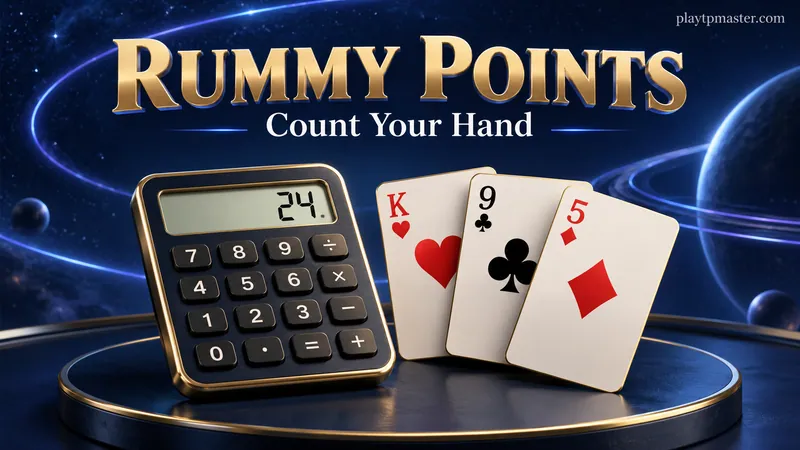
Assume twos are wild; this hand contains none. An opponent has ended the round with a valid declaration. Your two sequences meet the prerequisite, so the set of sixes is also excluded. Only K♥, 9♦ and 5♣ remain chargeable.
10 + 9 + 5 = 24 penalty points. The group sizes are 3 + 4 + 3 + 3 = 13. Those last three cards do not make a group just because you have placed them next to each other. They share neither a rank nor a consecutive same-suit pattern.
If you mistakenly added all thirteen cards, you would reach 91 before the cap. That would apply the wrong scoring branch. The key correction is the eligible grouping, not a different arithmetic operation.
Example 2: one pure sequence, but no second sequence
Assume aces are wild; there are no aces in this hand. The joker scores zero, but does not supply a missing second sequence on its own. Under the stated branch, exclude 3♥ 4♥ 5♥ only. Both sets still count.
(4 + 4 + 4) + (8 + 8 + 8) + 10 + 10 + 7 + 0 = 63. The pure sequence saves 12 points compared with counting the whole hand. Do not report only 27 by excluding the two sets: the second sequence condition has not been met.
This is the branch to confirm in the actual table rules. Some general summaries describe it less precisely; do not silently substitute a different scoring policy midway through a worked example.
Example 3: a single suit change removes the pure sequence
Again, aces are wild. The only change from Example 2 is 3♥ becoming 3♦. The first three cards are no longer a pure sequence. Even if you use PJ to represent 3♥, the resulting sequence is impure; it does not satisfy the pure requirement.
With no pure sequence, every card is chargeable: 3 + 4 + 5 + 12 + 24 + 10 + 10 + 7 + 0 = 75. Since 75 is below 80, the score remains 75. The two natural sets do not rescue this hand from the no-pure-sequence branch.
Example 4: what the 80-point cap actually does
Assume twos are wild. There are three natural sets and an unmatched ace, but no pure sequence. The ranks are too far apart to form a natural run, regardless of how you rearrange them. All thirteen cards therefore count.
40 + 36 + 24 + 10 = 110 before the cap. The recorded score is 80. Do not count only the ace merely because the other twelve cards form sets: without a pure sequence, those sets are chargeable too.
The cap is a ceiling, not an automatic score for every losing hand. A chargeable subtotal of 58 stays 58. Always establish the correct grouping and subtotal before applying the maximum.
Losing hand, wrong declaration and drop are different events
A normal losing hand is evaluated after another player finishes. An invalid declaration is your own failed attempt to finish. A drop is a separate action governed by the table’s timing rules. These are not interchangeable labels for the same calculation.
The cited Points Rummy rules specify 80 for a wrong declaration and 20/40 for first/middle drops. Those fixed values do not come from adding the cards above and must not be carried into every Pool, Deals or house-rule game. Before attempting to finish, run through our valid declaration checklist.
Practise the arithmetic
1. Eligible sequences are present. The only unmatched cards are A♦, 7♠ and 2♣; none is wild. What is the score?
10 + 7 + 2 = 19. The ace counts ten in this scoring system, not one.
2. Eligible sequences are present. Unmatched cards are K♣, 9♥ and PJ. What is the score?
10 + 9 + 0 = 19, assuming the king and nine are not wild. The printed joker adds no penalty points.
3. Does a raw subtotal of 81 become 81 or 80?
80 under the stated cap. First establish that 81 is the correct chargeable subtotal; the cap cannot fix an incorrect grouping decision.
A reusable score worksheet
- Write down the wild rank and the event being scored.
- Check for a pure sequence and a second sequence.
- Circle only the cards chargeable under that branch.
- Count each physical card once; use zero for jokers.
- Add the subtotal and apply the stated maximum.
If your answer differs from the game result, compare the submitted groups and rules before assuming the addition is wrong. For grouping practice, use sets versus sequences; for the full round, see the 13-card worked example.
Frequently asked questions
How many points is an ace in these examples?
Ten, unless it is a designated wild joker for the round, in which case it scores zero.
Does one pure sequence protect every set?
Not in the scoring branch used here. Without a second sequence, only the pure sequence is excluded.
Can a losing hand score fewer than 80?
Yes. Eighty is the cap in the stated ruleset. A chargeable subtotal of 24 stays 24.
Does a printed joker count toward the thirteen cards?
Yes. It is a physical card even though its penalty value is zero.
Are these scores cash amounts?
No. They are practice penalty points. No monetary conversion is used.
Rule sources and editorial note
Rule references checked on 15 October 2026. The hands, explanations and calculations on this page are our original practice examples. They do not reproduce an app screen or establish that a particular game is currently available.