
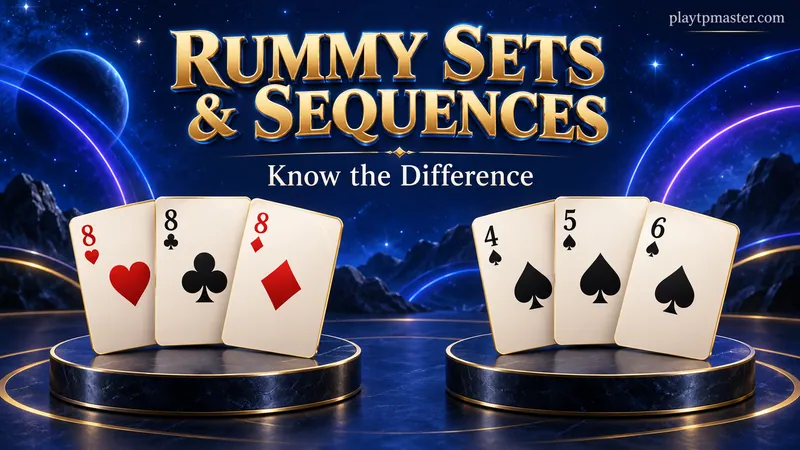
A set repeats a rank across different suits; a sequence follows consecutive ranks within one suit. Three eights can be a set. Four, five and six of spades can be a sequence. Neither a matching colour nor a tidy-looking fan of cards is enough to prove a group is valid.
This guide focuses on classifying individual groups before you check a whole 13-card hand. It uses ordinary Indian Rummy grouping rules, with PJ meaning a printed joker. Unless an example explicitly says otherwise, none of the numbered cards is wild. For the complete draw-and-discard process, start with our 13-card worked example.
On this page
The difference at a glance
| Check | Set | Sequence |
|---|---|---|
| Ranks | Same rank throughout | Consecutive ranks |
| Suits | Different suits | One suit, apart from a substituting joker |
| Natural example | 8♥ 8♣ 8♦ | 4♠ 5♠ 6♠ |
| Minimum size | Three cards | Three cards |
| Role in a declaration | Optional way to group remaining cards | At least two required; one must be pure |
Read rank and suit separately. In 8♥ 8♦ 8♣, every rank is eight even though the symbols differ. In 4♠ 5♠ 6♠, every symbol is a spade even though the numbers change. A sequence is not the same thing as a poker straight: mixed suits do not work here.
Five groups that look plausible but fail
| Cards | Verdict | Reason |
|---|---|---|
| 8♥ 8♣ 8♦ | Valid natural set | Same rank, three distinct suits. |
| 8♥ 8♥ 8♣ | Invalid set | Two decks can supply both hearts, but a set cannot repeat that suit. |
| 4♠ 5♠ 6♠ | Valid pure sequence | Consecutive ranks and one suit. |
| 4♠ 5♣ 6♠ | Invalid sequence | The club breaks the suit requirement. |
| 4♥ 6♥ 7♥ | Invalid sequence | The missing five leaves a gap. |
| Q♦ K♦ A♦ | Valid sequence in the ace-high rules used here | Ace is at the endpoint. |
| K♦ A♦ 2♦ | Invalid sequence | The run cannot wrap from king through ace to two. |
| 9♠ 9♦ | Incomplete group | A pair alone does not reach three cards. |
| J♠ Q♠ K♠ A♠ | Valid four-card pure sequence | A sequence does not have to stop at three. |
The duplicate-heart row is a physical-card example: imagine two separate 8♥ cards from two decks. It is not a typo. Moving them into one group does not turn repeated suits into different suits. Similarly, black cards are not one suit: spades and clubs remain different.
What changes when a joker is used?
In the first group, PJ stands for 5♠. The run is now complete but is impure because a missing card was replaced. In the second, PJ can represent a missing eight of a different suit. A joker can repair an eligible group; it cannot remove the requirement for a separate pure sequence.
A wild card used at its own printed rank and suit is a special case under rules that allow natural use. If fives are wild, 4♠ 5♠ 6♠ may still be pure because 5♠ is occupying its natural position. By contrast, 4♠ 5♥ 6♠ uses the five of hearts to replace the missing five of spades, so it is impure. Our pure-sequence guide explains this distinction.
Natural sets contain three or four cards. Some rules allow larger joker-assisted sets, while others restrict them. The examples here deliberately use ordinary three- or four-card sets; check the table rules before extending one with extra jokers.
Where should a shared card go?
There are two useful groups here: 6♣ 7♣ 8♣ as a pure sequence, and 8♦ 8♥ 8♠ as a set. Each of the six physical cards appears once. The tempting alternative is to place 8♣ with all the other eights, which leaves only 6♣ 7♣. That pair is not a complete sequence.
This is an arrangement exercise, not a claim that one discard is always best. First identify a complete partition of the cards you actually have. Do not count 8♣ in both a run and a set when checking a declaration. Moving a card can fix one group while breaking another, so recheck both affected groups.
A complete hand: check the groups, then the count
3 + 3 + 3 + 4 = 13 cards. Both sequences are pure, both sets use distinct suits, and no card is assigned twice. The hand meets the grouping requirement. There is no requirement to include an impure sequence just because jokers exist in the game.
Now replace J♠ with J♦. You still have thirteen cards, but 9♠ 10♠ J♦ is invalid, leaving only one sequence. Two good sets cannot compensate. This is why checking the total is necessary but insufficient. Follow the declaration checklist for a systematic whole-hand review.
Practise: identify the group before opening the answer
1. Is 10♥ J♥ Q♥ a set or a sequence?
A pure sequence: three consecutive ranks, all hearts. It is not a set because the ranks are different.
2. Is 2♠ 2♣ 2♦ 2♥ valid?
Yes, as a four-card natural set. All four ranks match and every suit is different.
3. Does 5♥ 6♦ 7♥ become valid because all cards are red?
No. Hearts and diamonds are different suits. It is neither a natural set nor a natural sequence.
4. Can one long sequence be counted as two?
Only if the actual cards can be partitioned into two separate eligible sequences of at least three cards each. A five-card run cannot do that. A six-card run may split 3 + 3, subject to the rest of the hand.
What to learn next
Group recognition answers “does this combination work?” It does not answer “how many points do I lose?” For that, use rummy points calculation with complete losing hands. Scoring can count cards from otherwise valid sets when the sequence requirements have not been met. Keep the grouping test and the scoring test separate.
Frequently asked questions
Is a set compulsory in 13-card rummy?
No. Eligible sequences alone can cover all thirteen cards. At least two sequences are needed, including one pure sequence.
Can two cards of the same suit form a set with another card?
Not if that repeats the same rank and suit within the set. Natural set members must share a rank and use distinct suits.
Is a sequence of four cards valid?
Yes, if all four are consecutive and satisfy the suit and joker rules. Three is the minimum length, not the only length.
Does a pair count as a set?
No. Two cards form an incomplete group in the 13-card rules used here.
Does a joker automatically make a sequence pure?
No. A substituting joker makes the sequence impure. Natural use of a designated wild card depends on the rules in force.
Rule sources and editorial note
Rule references checked on 15 October 2026. The hands, explanations and calculations on this page are our original practice examples. They do not reproduce an app screen or establish that a particular game is currently available.