
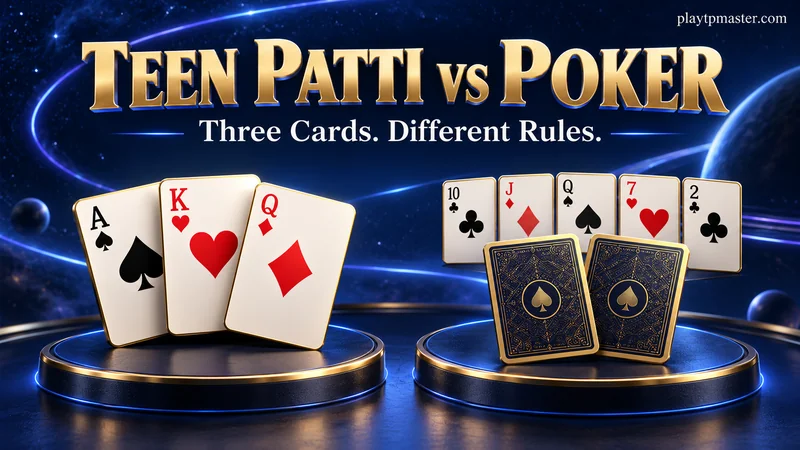
Teen Patti and Texas Hold'em both use playing cards and ranked hands, but they ask you to build different hands. Standard Teen Patti gives each player three private cards. Texas Hold'em gives each player two private cards and uses five shared community cards to form the best five-card hand.
Poker is a family of games. This comparison uses Texas Hold'em, the version many readers mean when they say “poker”; it does not describe every poker variant. Three Card Poker, for example, should not be treated as another name for either game here.
On this page
The differences that matter first
Swipe sideways if the table is wider than your screen.
| Feature | Standard Teen Patti | Texas Hold'em |
|---|---|---|
| Cards dealt privately | Three | Two |
| Shared community cards | None | Five by the river |
| Cards in the final hand | Three | Best five from seven available cards |
| Reading the table | Compare private three-card categories | Combine private cards with the shared board |
| Meaning of blind | A player who has not looked at their cards | A compulsory stake before the deal |
| Named board stages | No flop, turn or river | Flop, turn and river |
| Straight versus flush | Sequence ranks above colour | Flush ranks above straight |
| Equal hands | Apply the agreed Teen Patti show/tie rules | Equal best five-card hands normally split the relevant pot |
Before playing, establish the exact table rules. A word shared by both games is not proof that its procedure is shared too. This is especially important for blinds, shows and what counts as an equal hand.
Do not transfer the hand-ranking chart
Teen Patti uses six standard categories: trail, pure sequence, sequence, colour, pair and high card, in that order. Hold'em uses five-card poker rankings. With only three cards, a standard Teen Patti hand cannot contain a full house, four of a kind or two pair.
The most useful contrast for a beginner is sequence versus colour. In Teen Patti a mixed-suit sequence beats a non-sequential colour. In Hold'em a five-card flush beats a five-card straight. Memorising one chart and applying it to both games produces the wrong result.
Swipe sideways if the table is wider than your screen.
| Example comparison | Correct result | Reason |
|---|---|---|
| Teen Patti: 4♣ 5♦ 6♥ versus A♠ 9♠ 3♠ | 4♣ 5♦ 6♥ wins | Sequence beats colour |
| Teen Patti: Q♠ Q♦ 2♣ versus K♣ 9♥ 4♦ | Q♠ Q♦ 2♣ wins | Pair beats high card |
These are separate illustrative deals. For ace-high and ace-low runs, use the Teen Patti sequence list and agree the house convention; do not assume a poker convention settles A23 versus AKQ in Teen Patti.
A complete Hold'em hand comparison
Suppose the shared board is 9♣ 9♦ K♠ 4♥ 2♣. Player A holds A♠ K♦. Player B holds Q♠ Q♦. Each player evaluates five cards from the seven available to them, not just the two cards in their hand.
Swipe sideways if the table is wider than your screen.
| Player | Best five cards | Resulting hand |
|---|---|---|
| A | K♠ K♦ 9♣ 9♦ A♠ | Two pair: kings and nines, ace kicker |
| B | Q♠ Q♦ 9♣ 9♦ K♠ | Two pair: queens and nines, king kicker |
Player A wins because kings, the higher pair, outrank queens. The ace kicker is not needed to decide this example. Player B's private pair did not guarantee the stronger final hand once the board was considered.
This example has no direct three-card Teen Patti equivalent: two pair requires at least four cards. That is why comparing the names of private holdings is less useful than first asking how each game's final hand is constructed.
Can a Hold'em player use none of their private cards?
Yes. A player may use zero, one or two private cards when choosing their best five. Consider a board of 5♣ 6♦ 7♥ 8♠ 9♣, with Player A holding A♦ K♥ and Player B holding Q♣ J♦.
Both players' best hand is the board's nine-high straight. Neither can improve it with their private cards: Player B has no ten to extend the run. Their unused cards do not act as sixth- or seventh-card kickers. With equal best five-card hands, they share the relevant pot under normal Hold'em rules.
This is a useful test of understanding. If your answer changes because one player has an ace outside the best five, you are comparing too many cards.
Why blind means two different things
In Teen Patti, blind describes a player who has not looked at their cards; seen describes one who has. Those states affect permitted contributions under the agreed rules. In Hold'em, the small blind and big blind are forced stakes associated with positions, not a requirement to keep cards unseen.
Similarly, a Teen Patti sideshow is not the same procedure as a Hold'em showdown. Read the show and sideshow guide for the Teen Patti process instead of translating a familiar poker term word for word.
Which guide should you read next?
If you are learning Teen Patti, start with the standard rules and identify all six hand categories before learning variants. If you already play it and want to understand Hold'em, practise building the best five cards from a board and two private cards before studying more advanced situations.
Rummy requires a different comparison again: its sequences and sets are used to arrange a hand for a valid declaration. Our Rummy vs Poker guide explains that distinction. A three-card sequence, a five-card poker straight and a Rummy sequence belong to different rule systems, even when the cards look similar.
Use this article to transfer vocabulary carefully, not to decide that familiarity with one game makes another predictable or profitable. App interfaces, stake limits and local table rules are outside this comparison.