
This page focuses on comparing hands already classified in the same category and applying the stated settlement rule. For category recognition, use the Teen Patti sequence list and hand-ranking chart; for additional pair, colour and high-card examples, see Teen Patti tie rules.
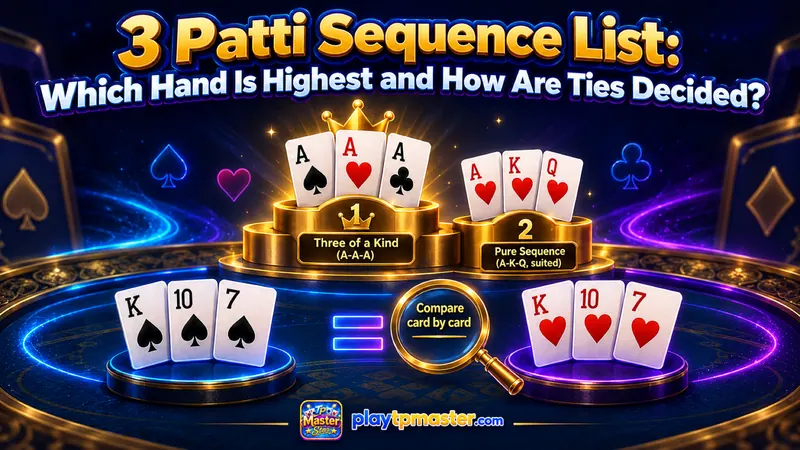
Three aces are the highest ordinary hand in classic 3 Patti. The full category order is trail, pure sequence, sequence, colour, pair, then high card. But knowing that list solves only the first part of a close result. When players hold the same category, you must compare the relevant ranks in the right order.
A further distinction matters: equal hand strength and a drawn round are not necessarily the same thing. Some Teen Patti rules penalize the player requesting a show when the hands tie. Other agreed formats settle equal hands differently. First compare the cards; only then apply the table’s settlement rule.
This guide uses standard single-deck Teen Patti without jokers and treats suits as equal in hand strength. Where a worked example needs a special settlement rule, that rule is stated explicitly.
On this page
The Short Ranking List
Swipe sideways to see every column.
| Category, strongest first | What decides a same-category comparison? |
|---|---|
| Trail | Rank of the three matching cards |
| Pure sequence | Rank of the run under the table’s ace convention |
| Sequence | Rank of the run under the same convention |
| Colour | Highest card, then second card, then third card |
| Pair | Paired rank first, then the remaining card |
| High card | Highest card, then second card, then third card |
There is no single “compare the biggest card” shortcut that works across all six categories. It fails when one hand has a lower pair with an ace kicker, and it fails when a low pure sequence faces a higher ordinary sequence.
Use a Three-Stage Comparison
First, classify both hands. If their categories differ, the higher category wins immediately. Do not continue comparing individual cards across categories.
Second, compare the ranks relevant to that category. For pairs, begin with the paired rank. For colours and high cards, sort the cards from highest to lowest and compare them one position at a time.
Third, if no rank difference exists, record an exact strength tie. Now check whether the comparison was a final show, accepted sideshow, automatic showdown, or a house-rule reveal. The context controls settlement; it should not change what the cards themselves are worth.
Pair vs Pair: When Does the Kicker Matter?
Suppose Asha holds 10♣ 10♦ 3♥ and Ravi holds 9♣ 9♦ A♠. Asha wins because tens outrank nines. Ravi’s ace is irrelevant once the pair ranks differ.
Now give Asha J♣ J♦ 8♥ and Ravi J♥ J♠ 6♦. Both have jacks, so the kickers decide: eight beats six. You do not compare the suits of the jacks or the order in which the cards were revealed.
Finally, compare J♣ J♦ 8♥ with J♥ J♠ 8♦. Both hands evaluate as a pair of jacks with an eight kicker. They have equal strength under suit-neutral rules. All six cards can coexist in a standard deck, so this is a genuine possible tie—not an impossible example using the same physical card twice.
That last check is useful when reviewing screenshots or teaching examples. A ranking explanation can be logically sound while its sample deal accidentally repeats a card that only exists once.
Colour vs Colour: Compare Every Necessary Position
Consider A♥ Q♥ 4♥ against A♣ J♣ 9♣. The aces match. The queen beats the jack, so the first hand wins without comparing four against nine.
Next compare K♦ 10♦ 7♦ with K♠ 10♠ 5♠. Here the first two positions match, and the seven beats the five. Stopping at “both king-high” would miss the deciding card.
An exact tie is possible with A♥ 9♥ 4♥ against A♣ 9♣ 4♣. The suits are different, but both hands have the same ordered ranks. A heart flush does not automatically outrank a club flush in ordinary Teen Patti comparison.
If a group deliberately uses ranked suits, that is a house rule to agree before dealing. It should not be introduced after someone sees a tied hand.
High Card: Why the Third Card Can Win
Compare A♠ 10♦ 6♣ with A♥ 10♣ 4♦. Neither hand has a pair, sequence, or colour. The aces match, the tens match, and the six beats the four.
This is an ordered comparison, sometimes called comparing kickers. It is not a points total. The cards are evaluated from most significant to least significant until one difference is found.
An ace-high hand also does not beat every hand without an ace. For example, A♠ J♦ 6♣ loses to 2♠ 2♦ 5♥ because even the lowest pair is a higher category than high card. Always perform classification before applying the high-card procedure.
Sequences: Same Run, Different Suits
The hands 8♣ 9♦ 10♥ and 8♦ 9♥ 10♠ are equal ordinary sequences. Both contain the same three consecutive ranks. Their different suit patterns do not create different run strengths.
However, 8♣ 9♣ 10♣ is a pure sequence. It beats either mixed-suit example because it belongs to a higher category. A player cannot claim a tie merely because the three rank values match.
Ace runs need the declared table order. A-2-3 may outrank A-K-Q in one implementation and rank below it in another. If the instructions do not explain the convention, resolve it before playing rather than guessing from poker or another app.
K-A-2 does not become a normal sequence under either convention. Recognizing an ace at one end of a run does not authorize it to connect the end and beginning of the ranking scale.
Can Two Players Tie with Trails?
Two different trail ranks are straightforward: three kings beat three queens. An equal-rank trail tie between two players is impossible in an ordinary single-deck deal, because six cards of that rank would be required and only four exist.
This does not mean every trail wins the round. A lower trail can lose to a higher trail. It means the exact same trail rank cannot be held by two players simultaneously under the stated deck assumptions.
Multiple decks or wild-card variants change those assumptions. If a joker represents a missing rank, consult the variant’s rules about substituted cards and equal hands rather than reusing the single-deck conclusion.
Final Show: A Worked Equal-Hand Settlement
Assume the table explicitly uses this rule: when two remaining players have equal hands at a requested final show, the requester loses. This is a documented Teen Patti convention, not a universal promise about every table.
Nila holds Q♣ Q♦ 7♥. Omar holds Q♥ Q♠ 7♦. Nila requests the final show. Their paired ranks and kickers match, so the hand comparison is equal. Under the stated settlement rule, Omar receives the pot because Nila requested the show.
It would be inaccurate to report that Omar had stronger cards. He did not; the settlement procedure decided the result. Keeping those explanations separate makes a disputed outcome much easier to understand.
Sideshow and Automatic Reveal Need Separate Instructions
A sideshow is a comparison within an ongoing round, usually involving eligible seen players. It is not automatically the same procedure as the last two players’ final show. Some rules require the sideshow requester to fold on equality, while some implementations describe a different outcome. Read the actual rule rather than borrowing the final-show tie policy.
For a teaching example, agree that the requester folds on an equal accepted sideshow. Priya requests a comparison with K♣ K♦ 9♥ against K♥ K♠ 9♦. The hands match, so Priya folds under that agreement. The round continues with the remaining players; the comparison does not by itself award the entire pot.
An automatic reveal at a pot limit creates another question: there may be no requester. A requester-loses rule cannot identify the result without additional instructions. The table needs an explicit policy for that situation, such as a specified split or other documented resolution.
A Compact Result-Checking Worksheet
Swipe sideways to see every column.
| Check | What to write down |
|---|---|
| Mode | Classic, joker, Muflis, or another named variant |
| Cards | Exact ranks and suits for both hands |
| Categories | Identify each category before comparing ranks |
| Deciding rank | Pair rank, run order, or first unequal card |
| Exact tie? | Yes only if all relevant rank comparisons match |
| Settlement context | Final show, sideshow, or automatic reveal |
For practice, deal face-up hands and explain each result using this worksheet. Use non-cash counters and agree the rules before introducing a pot. A ranking chart can settle card comparisons, but it cannot guarantee wins, verify an application, or replace the table’s stated rules for equal hands.