
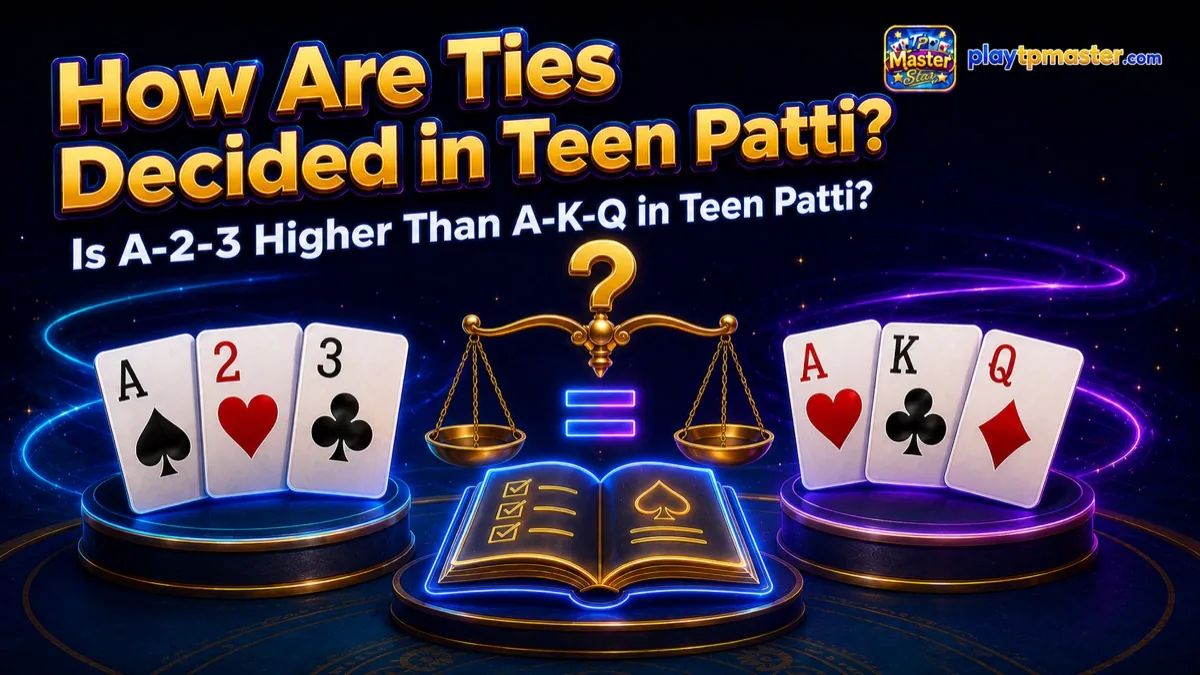
Two Teen Patti hands can belong to the same category without being equal. For example, two players may both have a pair, but the ranks of their pairs may differ. If the pairs match, the remaining card—commonly called the kicker—decides the winner. The same comparison principle applies to colour and high-card hands. Players compare the highest relevant card first, followed by the next card when necessary. Suits normally do not break a tie in traditional Teen Patti. Rules can vary between local games and mobile applications. In particular, some tables split an exactly tied pot, while others make the player who requested the show lose. Confirm the applicable table rules before playing.
Teen Patti Hand Rankings
Before comparing tied categories, players must identify the type of each hand.
| Rank | Hand | Example |
|---|---|---|
| 1 | Trail or Trio | A-A-A |
| 2 | Pure Sequence | A♥-K♥-Q♥ |
| 3 | Sequence | 9♠-8♦-7♣ |
| 4 | Colour | A♣-J♣-6♣ |
| 5 | Pair | Q♠-Q♦-8♥ |
| 6 | High Card | A♦-10♣-7♥ |
A higher category defeats every category below it. A pair always defeats a high-card hand, while a colour always defeats a pair. Tie-breaking rules are needed only when both players hold the same category.
Teen Patti Tie Rules at a Glance
| Matching category | First comparison | Second comparison | Final comparison |
|---|---|---|---|
| Trail | Rank of the three matching cards | Not required | Exact tie follows table rules |
| Pure Sequence | Sequence rank | Table-specific ace rule | Exact tie follows table rules |
| Sequence | Sequence rank | Table-specific ace rule | Exact tie follows table rules |
| Colour | Highest card | Second-highest card | Third-highest card |
| Pair | Rank of the pair | Rank of the unmatched card | Exact tie follows table rules |
| High Card | Highest card | Second-highest card | Third-highest card |
Traditional Teen Patti generally does not rank spades, hearts, diamonds and clubs against one another. A king of spades is not automatically stronger than a king of hearts.
How Are Trail and Sequence Ties Decided?
Trail vs Trail
When both players hold a Trail, compare the repeated rank. A-A-A beats K-K-K, Kings beat Queens, and so on. Suits do not normally create a second comparison for two Trails.
Pure Sequence or Sequence vs the Same Type
First confirm that both hands belong to the same category. A Pure Sequence defeats a regular Sequence regardless of the ranks inside those hands. When both are Pure Sequences—or both are regular Sequences—compare the sequence order used by the table. K-Q-J beats Q-J-10 under ordinary descending order.
Ace treatment requires a visible table rule because A-K-Q and A-2-3 are not ordered identically everywhere. See the worked A-2-3 vs A-K-Q sequence guide before applying either convention.
How Is a Pair Tie Decided?
A pair consists of two cards of the same rank and one unmatched card. When two players hold pairs, compare the pair ranks first.
Example 1: Different Pair Ranks
Player A: Q♠-Q♦-4♣ Player B: J♥-J♣-A♦
Player A wins because a pair of queens is higher than a pair of jacks. Player B’s ace does not matter because the pair is compared before the unmatched card.
This is an important beginner rule: a high kicker cannot overcome a lower pair.
Example 2: Same Pair, Different Kicker
Player A: 10♠-10♥-K♣ Player B: 10♦-10♣-8♥
Both players have a pair of tens, so the unmatched card decides the result. Player A wins because a king is higher than an eight.
The unmatched card is often called the kicker. It becomes relevant only after the pairs have been found to be equal.
Example 3: Exactly Equal Pair Hands
Player A: 7♠-7♥-Q♣ Player B: 7♦-7♣-Q♥
Both players have a pair of sevens with a queen kicker. Because suits normally carry no ranking, the two hands have the same value.
What happens next depends on the rules in use. The pot may be divided, or the player who requested the final show may lose the comparison. An app should state its exact-show rule in the help or game-information section.
How Is a Colour Tie Decided?
A colour, also called a flush, contains three cards of the same suit that do not form a valid sequence.
When two players have a colour, compare their highest cards. If the highest cards match, compare the second-highest cards. If those are also equal, compare the lowest cards.
The name of the suit normally does not determine the winner.
Example 1: Higher Top Card
Player A: A♥-9♥-4♥ Player B: K♣-Q♣-10♣
Player A wins because an ace is higher than a king. It does not matter that Player B’s remaining cards are closer together.
Example 2: Same Highest Card
Player A: A♠-J♠-6♠ Player B: A♦-10♦-9♦
Both hands have an ace as their highest card. The second card is therefore compared. Player A wins because a jack is higher than a ten.
Example 3: Same First and Second Cards
Player A: K♥-9♥-7♥ Player B: K♣-9♣-5♣
The king and nine match in rank, so the third card decides the result. Player A wins because seven is higher than five.
Example 4: Exactly Equal Colours
Player A: Q♠-8♠-3♠ Player B: Q♦-8♦-3♦
The card ranks are identical. Spades do not automatically defeat diamonds under standard Teen Patti rules, so the hands remain tied. The applicable split-pot or show-request rule must be used.
How Is a High-Card Tie Decided?
A high-card hand has no trail, pure sequence, sequence, colour or pair. The cards are arranged from highest to lowest and compared one position at a time.
Example 1: Different Highest Cards
Player A: A♣-9♦-5♥ Player B: K♠-Q♥-10♣
Player A wins because an ace is higher than a king. The queen and ten in Player B’s hand cannot compensate for the lower top card.
Example 2: Same Highest Card
Player A: A♠-J♦-4♣ Player B: A♥-10♠-9♦
Both players have an ace, so the second-highest card is compared. Player A wins because a jack ranks above a ten.
Example 3: Third Card Decides
Player A: K♣-J♥-8♦ Player B: K♦-J♠-6♥
Both players have a king followed by a jack. The final card settles the comparison, and Player A wins with an eight against a six.
Example 4: Identical High-Card Value
Player A: A♠-10♥-6♣ Player B: A♦-10♣-6♥
Both hands have exactly the same ranked cards. Since the suits normally have no comparative value, neither hand is naturally higher.
Do Suits Break a Tie in Teen Patti?
In most traditional Teen Patti games, suits are equal. Spades are not ranked above hearts, and clubs are not ranked below diamonds.
Some private games and digital apps introduce a suit hierarchy as a house rule. If a platform uses one, it should explain the order before the game begins. A suit hierarchy must not be assumed merely because it is used in another card game.
This distinction matters when two colour hands contain identical ranks. Under standard rules, neither colour wins solely because of its suit.
What Happens When Both Hands Are Exactly the Same?
Two players cannot hold precisely the same physical cards, but they can hold cards with identical ranks. For example, A♠-10♠-5♠ and A♥-10♥-5♥ have equal ranked values.
Teen Patti games commonly resolve this situation in one of two ways:
| Rule type | Result |
|---|---|
| Split-pot rule | The remaining players divide the pot |
| Show-request rule | The player who requested the show loses an equal comparison |
Side-show procedures may use another variation. In some versions, the player requesting a side show must fold when both hands are equal. Because these rules are not completely universal, players should check them before placing chips.
Do Blind and Seen Status Affect Hand Strength?
No. Blind and seen status affect how a participant plays and how much may need to be staked, but they do not change the mathematical rank of the cards.
A blind player’s pair of kings still defeats a seen player’s pair of queens. The same applies to colour and high-card comparisons.
Blind or seen status may affect who can request a show and how much it costs. Those procedural rules should not be confused with hand rankings.
Common Tie-Breaking Mistakes
A frequent mistake is using the kicker before comparing the pair. A pair of nines defeats a pair of eights even when the second player has an ace kicker.
Players also sometimes add all three card values together. Teen Patti does not normally decide colour or high-card ties by calculating a total. Cards are compared from highest to lowest.
Another error is assuming that a particular suit is stronger. Unless the table explicitly introduces a suit hierarchy, only the card ranks matter.
Frequently Asked Questions
If two players have the same pair, who wins?+
Compare the unmatched card. The player with the higher kicker wins. If the kicker ranks are also equal, apply the table’s exact-tie rule.
How do you compare two colours in Teen Patti?+
Compare the highest cards first. If they match, compare the second-highest cards and then the third-highest cards.
Does an ace kicker beat a higher pair?+
No. Pair rank comes first. A pair of queens with a low kicker defeats a pair of jacks with an ace kicker.
Does spades beat hearts in Teen Patti?+
Not under most traditional rules. Suits are normally equal, although an individual app or private table may establish a different house rule.
Can a Teen Patti pot be split?+
Yes, some rules divide the pot when the final hands have identical values. Other versions make the person who requested the show lose. Check the table rules.
Does the dealer decide a tie?+
The dealer should apply the agreed rules rather than choose a winner personally. In digital games, the app applies its programmed comparison system.
Responsible-Play Notice
Teen Patti contains a major element of chance because the cards are randomly dealt. Understanding tie rules can prevent mistakes, but it cannot guarantee a winning result.
Use points or non-withdrawable virtual chips when learning. If money or valuable stakes are involved, check the laws applying in your location and never use borrowed money or funds required for essential expenses.
Conclusion
Teen Patti ties are usually resolved by comparing the most important rank first. With pairs, compare the paired cards before the kicker. With colour and high-card hands, compare the highest card, followed by the second and third cards when necessary.
Suits generally do not break a tie. If every relevant rank is identical, the result depends on the table’s split-pot or show-request rule. Checking that rule before the game begins is the best way to avoid disputes.
How this guide is checked
Rank comparisons and worked examples are checked for internal consistency. Where Teen Patti tables or apps can use different sequence, suit or exact-tie rules, the variation is labelled instead of presented as universal.
Review Cycle: Every 90 days and sooner after a material table-rule or editorial update.
Editorial boundary
Play Teen Patti Master is an independent information site. We do not operate real-money games, accept ranking commissions, or guarantee a strategy, APK or payment outcome.
Read our editorial policy →