What qualifies as a Pure Sequence?
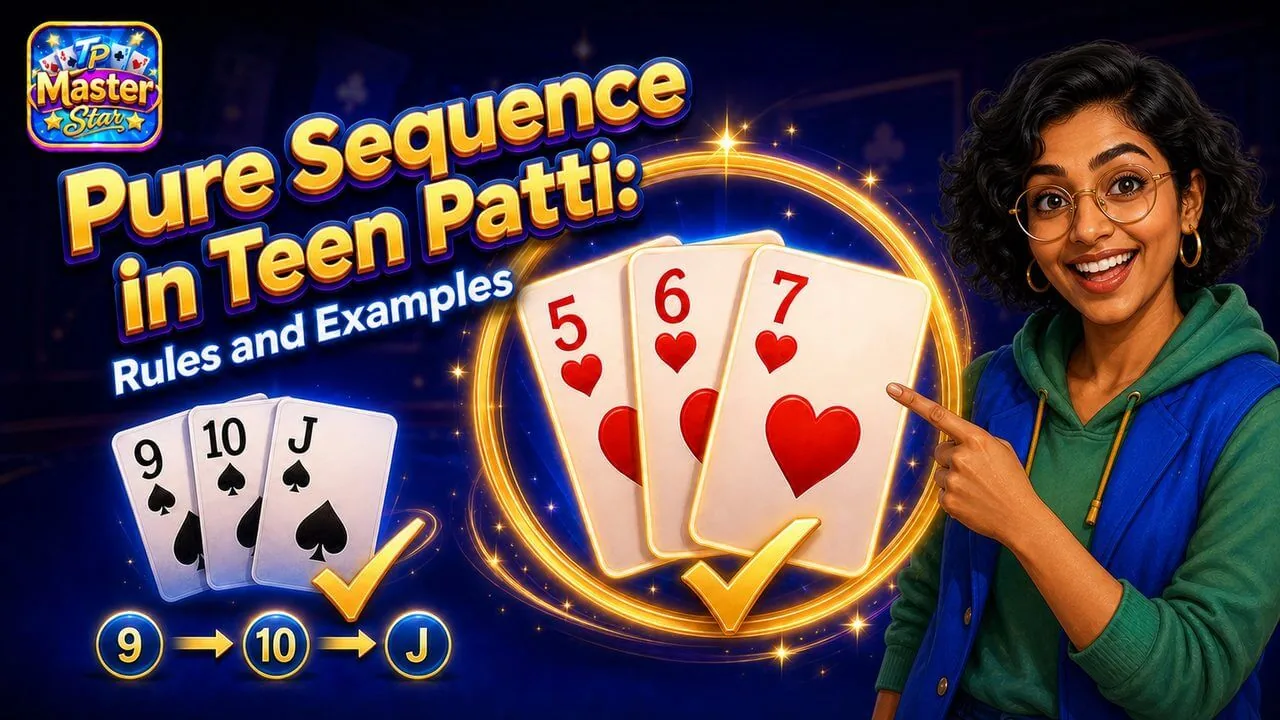
A Pure Sequence contains three consecutive ranks in the same suit. Both conditions must be true. If the ranks are consecutive but the suits are mixed, the hand is a Sequence. If the suit is the same but the ranks are not consecutive, it is a Color.
Valid Pure Sequence examples
| Hand | Why it qualifies |
|---|---|
| A♠ K♠ Q♠ | Consecutive high ranks, all Spades. |
| 9♥ 10♥ J♥ | Three consecutive Hearts. |
| 4♦ 5♦ 6♦ | Three consecutive Diamonds. |
Similar hands that are not Pure Sequence
| Hand | Correct category |
|---|---|
| A♠ K♠ J♠ | Color: same suit, but ranks are not consecutive. |
| 9♠ 10♥ J♦ | Sequence: consecutive ranks, mixed suits. |
| 7♣ 7♥ 8♣ | Pair: two Sevens and no sequence. |
| 2♠ A♠ K♠ | Not a standard run in many rule sets; verify the table. |
Ace examples need a table rule
A-K-Q is commonly accepted as a high Pure Sequence. A-2-3 can also be accepted, but its exact position differs between documented and house rules. Do not state a universal highest or lowest order without naming the rule set. 2-A-K is commonly invalid because the ranks do not form an accepted three-card run.
Pure Sequence vs Sequence vs Color
| Test | Result |
|---|---|
| Consecutive + same suit | Pure Sequence |
| Consecutive + mixed suits | Sequence |
| Not consecutive + same suit | Color |
In the standard category order, Pure Sequence ranks above Sequence, and Sequence ranks above Color. Use the sequence decision guide for a compact classification tool.
Comparing two Pure Sequences
Compare the sequence order defined by the active table. Suits do not normally add strength unless an explicit suit rule is displayed. If both hands have exactly the same ranks, apply the table's tie procedure.
Five-second classification checklist
- Sort the three ranks.
- Check whether they are consecutive under the table's Ace rule.
- Check whether all three suits match.
- Classify the hand before comparing it with another hand.
Frequently Asked Questions
Is A-K-J of one suit a Pure Sequence?+
No. It is a Color because the ranks are not consecutive.
Is 9-10-J with mixed suits a Pure Sequence?+
No. It is a regular Sequence.
Can A-2-3 be a Pure Sequence?+
It can be accepted under some rules, but its order must be checked at the active table.
Does one suit beat another?+
Not unless the active table explicitly defines a suit tie-break.
Editorial boundary
This guide explains common Teen Patti or Android concepts. Table rules, product availability, account eligibility and payment conditions can change. No content guarantees winnings, file safety or a payment result.
Read our editorial approach →How this guide is checked
This article follows our editorial standards: clear definitions, table-rule caveats, source checks where available, and no guaranteed-winning claims.
Corrections or feedback: support@playtpmaster.com
Read our editorial approach →Scheduled review: This article is scheduled for review every 90 days and sooner when the stated rules or cited official guidance materially change.