
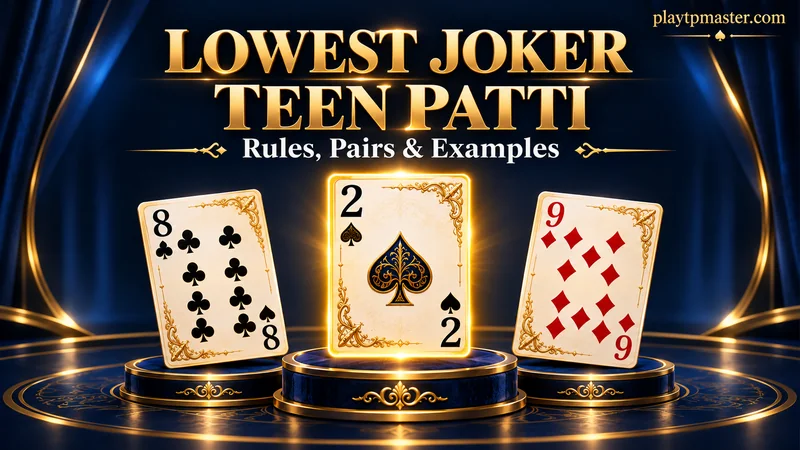
In Lowest Joker Teen Patti, a player’s own lowest-ranked card becomes wild. The important word is “own”: a three may be wild in one hand while a seven is wild in another. There is no need for one public joker rank shared by the whole table.
Pairs create the main rules question. Under the version used throughout this guide, every card tied for the lowest original rank becomes wild. A lowest pair therefore supplies two wild cards, not one. Other implementations can handle duplicates differently, so the table must state that detail before dealing.
Lowest Joker is not Muflis. You identify low cards to create jokers, then normally try to make the strongest hand. You do not automatically reverse the finished hand rankings.
On this page
The Rules Used in These Examples
Swipe sideways if the table is wider than your screen.
| Decision | Teaching convention |
|---|---|
| Deck | One standard deck without printed jokers |
| Deal | Three private cards per player |
| Original rank order | Ace high, then king down to two |
| Wild selection | All cards matching the lowest original rank in that hand |
| Selection timing | Determine once from the original deal |
| Objective | Make the strongest permitted three-card hand |
| Equal completed hands | No automatic preference for a natural hand |
For sequence examples, an assisted suited run occupies the pure-sequence ranking position in this teaching model. Some groups use different terminology or restrict that category when a joker is involved. Establish that policy separately from identifying the wild cards.
The conventional high-hand category order used here is trail, pure sequence, sequence, colour, pair, then high card. Substitution changes the combination you can form; it does not by itself change that category order.
Find the Joker Before Improving the Hand
Read the three original ranks and find the lowest. Mark that card, or those tied cards, as wild. Leave the other cards fixed. Only then consider what the wild cards should represent.
For 4♣ 9♦ K♥, the four is wild. It can stand for another king to create a pair of kings with a nine kicker. The nine does not also become wild after you imagine replacing the four. The selection is based on the original deal, not on a repeatedly modified hand.
That one-time rule prevents an endless chain of substitutions. Without it, a player could replace the lowest card, declare the next card lowest, and eventually turn everything wild. That is a different and poorly defined game, not the model described here.
Why Different Players Have Different Jokers
Suppose Maya receives 3♣ 10♦ 10♥ and Dev receives 7♠ Q♣ Q♦. Maya’s three is wild; Dev’s seven is wild. Maya can make a trail of tens, while Dev can make a trail of queens. Dev wins because queens outrank tens.
Dev’s seven does not turn every seven at the table wild. If another player holds 2♥ 7♦ J♣, that player’s two is the wildcard and the seven remains natural. Wildness belongs to the personal selection rule, not to a declaration made by someone else.
This is the main difference from a fixed-rank joker game. In a fixed-rank game, the table might nominate all sixes before play. In Lowest Joker, the contents of each hand determine its own wild rank.
When the Lowest Cards Form a Pair
Consider 5♣ 5♦ Q♥. Both fives share the lowest original rank. Under the stated duplicate-low rule, both become wild and can represent Q♣ and Q♦. The finished hand is a trail of queens.
Contrast that with 5♣ Q♦ Q♥. Here only the five is wild, but it can still complete three queens. These two original hands have different numbers of wild cards yet reach the same evaluated result.
Swipe sideways if the table is wider than your screen.
| Original hand | Wild cards | Strongest result in this model |
|---|---|---|
| 5♣ 5♦ Q♥ | Both fives | Trail of queens |
| 5♣ Q♦ Q♥ | Five only | Trail of queens |
| 3♣ 3♦ K♥ | Both threes | Trail of kings |
| 3♣ K♦ K♥ | Three only | Trail of kings |
Each row is an independent example, not a simultaneous deal. The table demonstrates why counting jokers is not enough to name a winner. Compare the finished hand, including its rank.
If a table says only one physical card becomes wild, ask how it chooses between tied low cards. That choice must be defined before the reveal. Do not assume that “a pair becomes joker” means removing two physical cards and leaving a two-card hand.
What Happens with Three Equal Cards
In 8♣ 8♦ 8♥, all three cards tie for lowest. A rule that makes every tied-low card wild therefore produces three wild cards. For this teaching model, permit them to form the highest trail, three aces.
That conclusion follows from the declared convention, not from the name Lowest Joker alone. An implementation could preserve a natural trail or use another special rule. If its instructions address only a lowest pair, they have not necessarily answered the three-equal-cards question.
A good home-game rule sheet states the result explicitly. Otherwise, the unusual hand becomes the moment players discover they have been assuming different rules.
How Aces Affect Wild Selection
With ace high, A♠ 2♦ 3♥ makes the two wild. The ace remains an ace; it does not become the lowest card merely because A-2-3 is a recognized sequence in classic play.
Choosing the joker and ranking an ace sequence are separate operations. A table may rank A23 first among sequences while still using ace high to identify the lowest original card. Write down both decisions instead of using the vague statement “ace is high” to cover everything.
Under an explicitly different ace-low selection rule, A♠ would become wild in that same hand. This can alter the available combinations. Do not transfer examples between those two systems without recalculating the wildcard first.
Building Sequences with One Wild Card
Take 2♣ 8♥ 9♥. The two is wild and can represent 10♥, creating an assisted 8-9-10 suited run under our category convention. It could also represent 7♥, but 8-9-10 is the higher of those two runs.
Now change the nine to 9♦. The same wildcard can complete a mixed-suit sequence, but it cannot change either natural card’s suit. One joker does not turn 8♥ and 9♦ into two hearts. This is a useful check against overvaluing wild hands.
For 2♣ 8♥ Q♦, the natural ranks are too far apart for one missing card to complete a three-card run. A pair of queens with an eight kicker is a stronger available interpretation than treating the hand as unrelated high cards.
Compare Hands Without Giving Jokers Extra Points
Use the strongest permitted interpretation of each hand, compare categories, then compare the relevant ranks. A wild card has no independent bonus value added to the result.
If two hands both evaluate as three kings, they are equal in card strength under the stated model. Their original low ranks do not break that tie. The table’s settlement rule then controls whether a requester loses, the pot is shared, or another agreed procedure applies.
Practise by announcing three things: the original lowest rank, the substitution, and the completed category. That explanation makes errors visible without complicated scoring. Use valueless counters and a planned finish time; understanding a variation helps you read results, but does not guarantee favourable deals or justify chasing losses.