
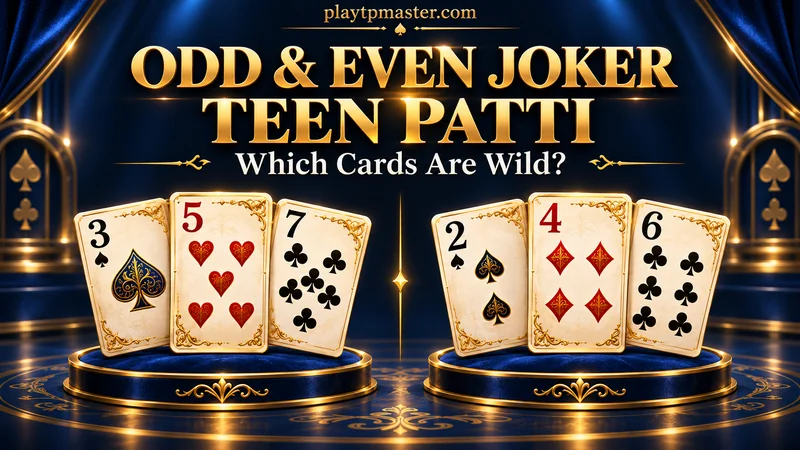
Odd Joker makes cards in a declared odd-number group wild. Even Joker does the same for a declared even-number group. The difficult part is not recognizing that five is odd or eight is even. It is establishing whether aces and face cards belong to either group and which numerical values the table assigns them.
There is no safe way to answer that question from the mode name alone. A table using values A=1, J=11, Q=12, K=13 produces a different joker set from a table that includes only printed number cards. This guide compares those two explicitly defined teaching conventions rather than claiming that every app implements one universal version.
On this page
Choose a Mapping Before Dealing
In the full-rank numerical convention, assign A=1, numbered cards their printed values, J=11, Q=12, and K=13. Odd Joker then makes A, 3, 5, 7, 9, J, and K wild. Even Joker makes 2, 4, 6, 8, 10, and Q wild.
In the number-cards-only convention, only ranks 2 through 10 participate. Odd wild ranks are 3, 5, 7, and 9; even wild ranks are 2, 4, 6, 8, and 10. Aces and face cards remain natural in both modes.
Swipe sideways if the table is wider than your screen.
| Card | Full-rank value | Full-rank classification | Number-cards-only classification |
|---|---|---|---|
| A | 1 | Odd | Neither |
| 2 | 2 | Even | Even |
| 9 | 9 | Odd | Odd |
| 10 | 10 | Even | Even |
| J | 11 | Odd | Neither |
| Q | 12 | Even | Neither |
| K | 13 | Odd | Neither |
Neither table is a statement about the current Teen Patti Master application. Use the actual selected mode’s definition if it differs. These mappings are useful because every card has an explicit status, leaving no face-card question to resolve after the deal.
Do Not Borrow Values from Another Game
In some scoring systems, face cards count ten points. That does not automatically make J, Q, and K even jokers in Teen Patti. Penalty values, sequence positions, and wildcard-selection values serve different purposes.
An ace creates a similar trap. If a table uses A=1 for parity, the ace is odd for wildcard selection. That does not by itself determine whether A23 outranks AKQ when evaluating sequences. The table must define sequence order independently.
The numbers also do not become a points total for the hand. Under ordinary high-hand evaluation, you still compare trail, suited run, ordinary run, colour, pair, and high card. A hand does not win merely because its assigned numerical values add up to more.
The Evaluation Rules for These Examples
Each example uses three cards from one standard deck. A wild card can represent a missing rank and suit, while natural cards remain unchanged. Use the strongest permitted interpretation.
For these teaching examples, assisted suited runs occupy the pure-sequence ranking position. Three wild cards may form a trail of aces. Equal completed hands receive no extra preference for being natural or for using fewer jokers. If your table restricts assisted sequences or uses natural-hand priority, its outcomes can differ.
Do not merge these assumptions with Lowest Joker. Odd and Even use table-wide rank groups: a seven is wild for everyone in the full-rank Odd mode, not only for the player whose seven happens to be their lowest card.
Same Hand Different Mode
Consider 5♣ Q♦ Q♥ using the full-rank numerical mapping. In Odd mode, the five is wild and both queens are natural. The five can become Q♠, producing three queens.
In Even mode, the queens are wild while the five remains natural. They can become two additional fives, producing three fives. Both versions yield a trail, but not the same trail. The hand cannot become three aces in Even mode because the natural five must remain in the final three-card hand.
Swipe sideways if the table is wider than your screen.
| Original hand | Odd mode result | Even mode result |
|---|---|---|
| 5♣ Q♦ Q♥ | Trail of queens | Trail of fives |
| 2♣ 8♥ 9♥ | Pair of eights with a two kicker | Trail of nines |
| A♣ J♦ K♥ | Three wild cards form trail of aces | Natural mixed-suit high-card hand |
The rows are separate examples. The second row is particularly useful: in Odd mode the nine alone is wild, and the natural two and eight cannot be joined into a three-card run. In Even mode both even cards are wild and can complete three nines.
A Face Card Can Change the Whole Comparison
Return to 5♣ Q♦ Q♥ under the number-cards-only mapping. Odd mode still makes the five wild, so the hand can form three queens. Even mode now makes none of its cards wild, because queens are excluded and five is odd. It remains an ordinary pair of queens with a five kicker.
Compare that with the full-rank Even outcome of three fives. The same printed cards have changed category solely because the table changed how queens are classified.
This is why an explanation saying “even cards are jokers” is incomplete. Ask whether Q counts as twelve, whether faces are excluded, or whether the table uses another explicit mapping. Do not fill the gap with whatever rule produces the strongest hand for you.
How Many Wild Cards Are in the Deck?
A standard deck has four cards of each rank. The full-rank Odd group contains seven ranks, so there are 28 wild cards in the deck. The full-rank Even group contains six ranks, producing 24 wild cards.
Under number-cards-only selection, Odd has four wild ranks and therefore sixteen wild cards. Even has five wild ranks and therefore twenty. Those counts explain why two versions with similar names can feel quite different.
They do not guarantee a particular hand or establish a player’s chance of winning a round. A count of wild cards in the deck is not the same as the probability of beating opponents after everyone has made their best substitutions. Avoid treating a joker-rich mode as an automatic advantage over everyone else playing it.
Common Errors to Catch Early
One error is changing a natural card along with the joker. If you have 2♣ 8♥ 9♥ in Odd mode, the nine can change, but the two cannot become a seven to help create a run. Substitution is limited to cards already identified as wild.
Another is deciding the mapping after viewing the hand. Moving a queen into or out of the even group to improve a result is a rule change, not an interpretation. Display the mapping before the shuffle.
A third is treating “more jokers” as the final comparison. Two wild cards supporting a natural five may make three fives, while one wildcard supporting two queens can make three queens. The latter is stronger despite using fewer jokers.
A Clear Rule Card for Friends
Write the active mode, the exact wild ranks, ace-sequence order, assisted-sequence policy, and equal-hand settlement on one card. If alternating Odd and Even between rounds, announce the change before dealing and keep the current mode visible.
Begin with face-up practice and ask each player to name the wild cards before naming the best hand. That separates a classification error from an evaluation error. Use non-cash counters and fixed session limits. The point of trying the variation is to understand a different card puzzle, not to promise easier winnings or encourage higher stakes.